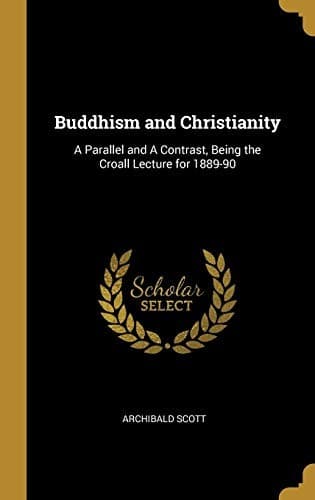
Buddhism and Christianity: A Parallel and a ContrastScott, Archibald
Religion
Buddhism and Christianity: A Parallel and a Contrast
Scott, Archibald
Buddhism -- Relations -- Christianity; Christianity and other religions -- Buddhism
never undergone a true revival. It can boast of many ecclesiastics and
philosophers, but for hundreds of years it cannot point in its
honour-roll to either a Xavier or a Livingstone. It has long ago ceased
to be aggressive. At this day no Oriental Buddhist seriously
contemplates becoming a missionary. Paris may add to its attractions and
curiosities a real Buddhist temple,[273] but the priests who officiate
in it, however devoted they may be to their cult, will certainly never
dream of taking the trouble of preaching it in the streets.
In the Church of the middle ages, supposed to consist only of pope and
bishops and clergy and monks and nuns, of which mediævalism a remnant
survives in those who speak of “entering the Church,” not when as
children they are baptized into its communion, but when they are to be
ordained to service in it, we must look for any resemblance to the
Buddhist Sangha. In ancient India, a church, meaning the fellowship of
the faithful in its totality, was an impossibility. Brahmanism had no
church, and never attempted a conversion, but Buddha in seeking to
rescue others from evil, and in offering a place of escape which they
were free to accept or reject, created not a church but a precursor of
one.[274] Admission into his Brotherhood was at first open to all who
requested it, but as disciples crowded around him, and parents
complained that they were bereaved of their children, and masters that
they were robbed of their slaves, and creditors that they were deprived
of what was owing by their debtors, and even the judges that criminals
escaped the prison; and when accusations grew frequent and loud that the
new movement would ruin households, injure the State, and depopulate the
country, restrictions were devised. Gradually conditions were imposed by
which all who were diseased, or criminals, or soldiers, or debtors, or
slaves, or children under fifteen years of age, or youths under twenty
who had not received their parents’ consent, were disqualified.[275] At
first the disciple was admitted without any ceremony, beyond that of
shaving the whole head, and putting on the yellow robes which
distinguished the ascetic and the recluse, but eventually a rite of
initiation was adopted, which in Ceylon has continued substantially
unaltered to this day.
Public-domain text, read in full here on John Shaqi.
Reviews
Reviews
No reviews yet
Be the first to share your thoughts on this work.
Elsewhere in the archive
Join the Discussion
Join the discussion
Sign in to leave a comment or review.
Sign InorCreate an account