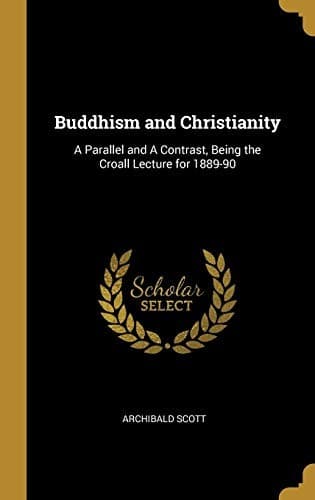
Buddhism and Christianity: A Parallel and a ContrastScott, Archibald
Religion
Buddhism and Christianity: A Parallel and a Contrast
Scott, Archibald
Buddhism -- Relations -- Christianity; Christianity and other religions -- Buddhism
The part played by woman in the early history of Buddhism was analogous
to that assumed by woman in relation to primitive Christianity. Women
were among the most zealous supporters of Buddha, ministering to him of
their substance. Subsequently, as in the case of the Christian Church,
the largest proportion of the wealth which was lavished in such
marvellous munificence upon the Order came from female votaries.
Evidently in those days in India the position of woman was not so
degraded and helpless as it afterwards became. Women in old Indian
literature are seen to be much more on an equality with men; they are
not only represented as receiving scholastic instruction, but even to
them as authoresses some of the Vedic hymns were ascribed.[298] At any
rate, women appear in almost every Buddhist episode, and they move about
with a freedom which contrasts strangely with the seclusion and
restraint in which in India they have lived for ages. In the character
of Buddha there seems to have been much that was peculiarly attractive
to the best type of women, and at least one of these stands forth with
very clearly marked individuality.[299] His mother is only a shadow in
the legends, and we can only conjecture what the parent of so good and
gentle a man must have been. But his wife confronts us with so much that
is womanly in the picture that we feel she must have been drawn from
life. Very pathetic and tender is the graphic account of her first
interview with him, upon his return as the illustrious Buddha to his
father’s house.[300] When all came to do him honour, Yasodhara did not
come, for she said, “If I am of any value in his eyes, he will come
himself, and I can welcome him better here.” Buddha, noting her absence,
went attended by two of his disciples to the place where she was, and he
warned his companions not to prevent her should she seek to embrace him,
although no member of the Order could touch or be touched by a woman.
And when she saw him, a mendicant in yellow robes, with shaven head and
face—though she knew it would be so—she could not contain herself, but
fell at his feet, which she held, passionately weeping. Then remembering
the great and impassable gulf which he had fixed between them, she rose
and stood at his side. His father sought to apologise for her, telling
how in the greatness of her love she mourned and afflicted her soul for
loss of him, and refused to be comforted. She became his disciple; and
when afterwards, much against his inclination, he admitted women into a
separate branch of the Order, the poor wife, whom he had not only
widowed, but had bereft of her only child, “passed into the silent
life,” as one of the first of Buddhist nuns.
Public-domain text, read in full here on John Shaqi.
Reviews
Reviews
No reviews yet
Be the first to share your thoughts on this work.
Elsewhere in the archive
Join the Discussion
Join the discussion
Sign in to leave a comment or review.
Sign InorCreate an account