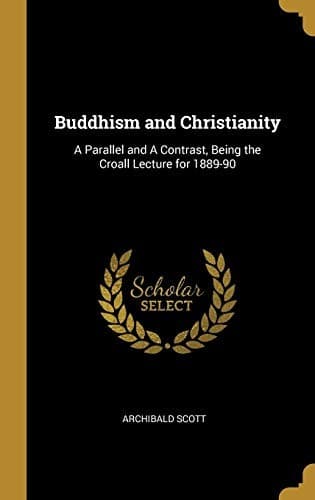
Buddhism and Christianity: A Parallel and a ContrastScott, Archibald
Religion
Buddhism and Christianity: A Parallel and a Contrast
Scott, Archibald
Buddhism -- Relations -- Christianity; Christianity and other religions -- Buddhism
The Sangha, as a brotherhood and sisterhood leading a celibate life,
coupled with abstinence from labour and from active services of charity,
was simply vicious in its tendency, and it proved one of the most
obstinate hindrances to the realisation of Buddha’s best ideas, and one
of the most powerful factors in the degradation of his religion. Human
nature was too strong to submit to such artificial restrictions; so very
early there gathered around him and his monks many who would not abandon
their families and their callings, though they took refuge in Buddha,
and proved the reality of their devotion by faithful service of the
Order and practice of the Law. These were the votaries, “upasaka”
(masc.), “upasika” (fem.), corresponding with the lay associates of the
great Mendicant Orders of Christendom. Converted to the observance of
the precepts, they could only, as long as they continued in the world,
be sustained by a very faint and far-off hope of deliverance.
Theoretically they might attain to sainthood, and from “this shore” of
common life, in most exceptional cases they might “pass across the
dominion of death,” and reach to the other shore.[312] The father of
Buddha is said to have done so on his deathbed, and another is recorded
in the legends as having gained Nirvana.[313] As a rule, however, it was
reckoned impossible for them to gain what was considered as so barely
possible for the Order of Mendicants, that only one or two even of them
did actually gain it here. Pious votaries, however, could hope for a
happy re-birth, and for strength of merit to be acquired; in some
hereafter sufficient to enable them eventually to pluck the fruit of
Nirvana. For such lay associates no ceremony of initiation was required;
only in presence of a monk the candidates made profession that they took
refuge in Buddha and Dharma and Sangha. They had to observe certain
precepts and prohibitions; had to renounce any trade involving the
making or selling of arms, or the killing of animals; they had to
abstain from all traffic in and use of intoxicating drinks, and to put
far away from them all falsehood, and theft, and unchastity. To seal
this, however, no formal vow was demanded of the votary, and to maintain
them in their obedience no pastoral supervision was accorded. When they
transgressed, even in the matter of scandalous living, there was neither
censure nor discipline, and when they offended by injuring the Order or
insulting one of its members, the only penalty inflicted was the refusal
of their invitations to dine, and the withdrawal from them of the
alms-bowl.[314] Into the Uposatha assemblies they dared not intrude, and
from the very slightest share of the business of the Order they were
strictly excluded.[315] They could only listen to the preaching of the
monks, whom they could feed, and lodge, and endow with houses and lands;
and all the reward they could hope for, was the prospect of acquiring in
Public-domain text, read in full here on John Shaqi.
Reviews
Reviews
No reviews yet
Be the first to share your thoughts on this work.
Elsewhere in the archive
Join the Discussion
Join the discussion
Sign in to leave a comment or review.
Sign InorCreate an account