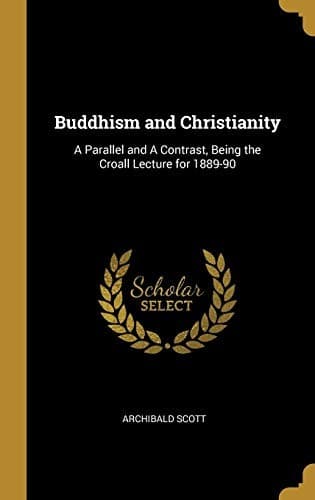
Buddhism and Christianity: A Parallel and a ContrastScott, Archibald
Religion
Buddhism and Christianity: A Parallel and a Contrast
Scott, Archibald
Buddhism -- Relations -- Christianity; Christianity and other religions -- Buddhism
Mahâ-pagâpati the Gotami, his aunt and nurse (Kullavaga, x. 1) whose
entreaty, through Ananda, led him to found the Order of Bikkhuni,
seems more than a name. Visâkhâ, “the rich and bountiful,” is another
type of votary (Mahavagga, viii. 15).
Footnote 300:
_Buddhist Jataka Stories_, translated by Rhys Davids, pp. 87, 90;
Bigandet, _Life of Gaudama_, old ed., pp. 156, 168.
Footnote 301:
Dhammapada, 284; _Sacred Books of the East_, vol. x.
Footnote 302:
Book of the Great Decease, v. 23; _Sacred Books of the East_, vol. xi.
Footnote 303:
Eitel, _Lectures on Buddhism_, p. 10.
Footnote 304:
Kullavagga, x. 1. 3, 4; _Sacred Books of the East_, vol. xx.
Footnote 305:
Clement of Alexandria gives prominence to the value of marriage and of
the family life, _Strom._ vii., _Paedag._ iii. So Tertullian, _Ad
Uxorem_, ii. c. 8.
Footnote 306:
Principal Donaldson, _Contemporary Review_, Sept. 1889.
Footnote 307:
Sir Henry S. Maine, _Early History of Institutions_, p. 341.
Footnote 308:
Kullavagga, x. 1. 6.
Footnote 309:
Kullavagga, x. 1. 27.
Footnote 310:
Pâtimokkha; Pakittiyâ Dhammâ, 6, 7, 27, 66, 67.
Footnote 311:
“You are not, O monks, to bow down before women, to rise up in their
presence, to stretch out your joined hands towards them, nor to
perform towards them those duties that are proper to them (from an
inferior to a superior).”—Kullavagga, x. 3. 1. “Giving honour unto the
wife, as unto the weaker vessel, and as being heirs together of the
grace of God.”—1 Peter iii. 1-7.
Footnote 312:
Dhammapada, 85, 86; _Sacred Books of the East_, vol. x.
Footnote 313:
T. W. Rhys Davids, _Handbook of Buddhism_, p. 125; Spence Hardy,
_Eastern Monachism_, p. 199.
Footnote 314:
The bowl was “turned down” in relation to him, and his house became an
unlawful resort.—Kullavagga, v. 20. 3; _Sacred Books of the East_,
vol. xx.
Footnote 315:
Sir Monier Williams states that though votaries did not confess to
monks, the four days were observed by them.—_Buddhism_, p. 84.
Footnote 316:
Oldenberg, _Buddha, etc._, p. 162 note.
Footnote 317:
Mahavagga, vi. 24. 1-6.
Footnote 318:
Kullavagga, vi. 1-5; _ibid._ vi. 4. 10.
LECTURE VI.
THE TWO RELIGIONS IN HISTORY.
I.—External Diffusion.
Public-domain text, read in full here on John Shaqi.
Reviews
Reviews
No reviews yet
Be the first to share your thoughts on this work.
Elsewhere in the archive
Join the Discussion
Join the discussion
Sign in to leave a comment or review.
Sign InorCreate an account