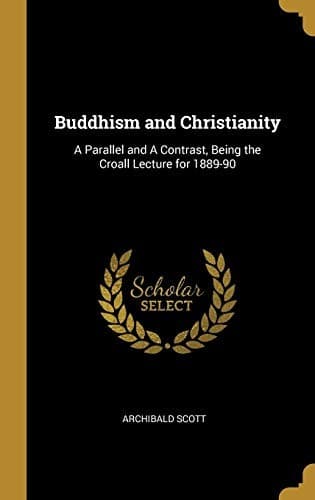
Buddhism and Christianity: A Parallel and a ContrastScott, Archibald
Religion
Buddhism and Christianity: A Parallel and a Contrast
Scott, Archibald
Buddhism -- Relations -- Christianity; Christianity and other religions -- Buddhism
Unquestionably this belief in the presence of Christ in the
Spirit—whether truly founded or not—was universal in the Church. All
the utterances of primitive Christianity, the scriptures of its
apostles, the treatises of its fathers and doctors, and all the
monuments of the first ages, bear witness not to a Christ who once
lived and had died, but who was living triumphant and glorified,
reigning for them, and in them to reign. Unquestionably also in this
belief was the hiding of that power which enabled the Church to
confront the whole world, endure the full weight of its persecutions,
and finally win the victory over it. It also explains the appearance
in the Church, from the first, of that succession of persons who,
because of their strongly marked individualities, gave both direction
and impetus to its progress. Buddhism, though both its southern and
northern scriptures record a patriarchal succession, and though
probably not deficient in highly cultured disciples, seems to have
lacked from the very first men who had genius to organise or intellect
to command its forces. Its own early writings disclose a movement
which very speedily congealed, because ruled only by a remembered law,
interpreted by very adulterated traditions. Christianity represents
quite a different movement; it was not the perpetuation of a system,
but the development of a new inspiration, of a life manifested in
Christ and communicated to all who believed on Him. Consequently it
never was without its heroes, whom it had the power to produce; and
consequently also it never could stiffen into a tradition, for where
its leaders attempted to fix it, in either confession or in ritual, it
was sure to evade them. It has been appropriately described as “the
most changeable of religions,”[321]—mutable in its forms, immutable in
its essence. For Christianity is not a system either of philosophy or
theology; it is a perpetually reforming spirit, fed by faith in One
who is the same yesterday, and to-day, and for ever.
Public-domain text, read in full here on John Shaqi.
Reviews
Reviews
No reviews yet
Be the first to share your thoughts on this work.
Elsewhere in the archive
Join the Discussion
Join the discussion
Sign in to leave a comment or review.
Sign InorCreate an account