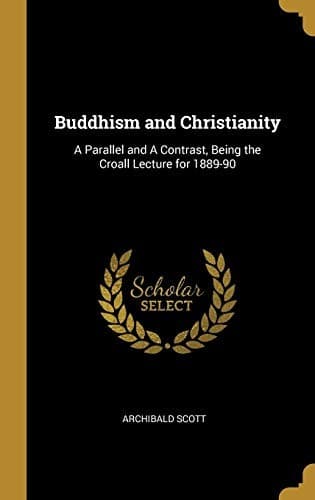
Buddhism and Christianity: A Parallel and a ContrastScott, Archibald
Religion
Buddhism and Christianity: A Parallel and a Contrast
Scott, Archibald
Buddhism -- Relations -- Christianity; Christianity and other religions -- Buddhism
To this coming one, the Buddha of “kindness and
mercy”—thought to be a personification by some imaginative poet of the
gentle spirit of Buddhism—the thoughts and the hopes of the disciples
turned, and out of this hope arose a doctrinal system, which, expanding
and enlarging by manifold additions as the time went on, showed that
however atheistic the original creed might be, the religion itself had
become polytheistic.[356] To Mâitrêya, in his glorious heavens, the
deliverer of distant generations, prayers ascended, and worship was
rendered by all Buddhists everywhere alike; and out of this cult by far
the largest section of them began to evolve deity after deity, till the
heavens, in which Buddha could find no superior to himself, were crowded
with objects of idolatrous regard.
In this polytheistic development a very great distinction emerged
between the Northern or Mahāyāna and the Southern or Hināyāna system of
Buddhism. How the divergence originated has not been clearly
ascertained, but about the beginning of the Christian era it seems to
have been very manifest, and at that time, when sectarian controversy
and philosophical speculation threatened to rend the system into
fragments, Nâgârdjuna,[357] a monk of Nâlanda, is said to have done for
Northern Buddhism what Gregory and Benedict did for the Western Church.
Under him, and certainly after him, Northern Buddhism, both in respect
of expansive power and of dogmatic and ritualistic development, left
Southern Buddhism far behind it. The Hināyāna, or the “little way” of
deliverance, is believed to have been applied by the Northern, not
without contempt for the Southern school’s arrestment. They did not
profess to contradict the Southern faith: they simply included it, and
advanced in their “great way” beyond it. To the Southern the _summum
bonum_ of life meant Arhatship, for that once attained there would be no
more re-birth. They acknowledged and worshipped only one Bôdhisatva, the
coming Mâitrêya; but the doctors of the North, properly conceiving the
estate of the Bôdhisatva to be nobler than that of Arhat, propounded it
as the goal of aspiration. Arhatship would indeed secure one’s own
deliverance; but Bôdhisatvahood would enable them, as possible coming
Buddhas, to confer the blessings of deliverance upon countless
multitudes. Along with Mâitrêya they discovered many persons who, like
Buddha’s great disciples and their successors, had through merit,
acquired in a long series of lives, taken his Tushita heavens by
violence; but who, unlike him, were under no obligation to quit their
celestial abodes, and proceed through Buddhahood to Nirvana. They might
enjoy their blessedness to the full, and sit beside their nectar without
concern, for they fulfilled every function expected of them in being
objects of worship, to whom mortals could appeal for comfort in sorrow
and help in time of need.
Public-domain text, read in full here on John Shaqi.
Reviews
Reviews
No reviews yet
Be the first to share your thoughts on this work.
Elsewhere in the archive
Join the Discussion
Join the discussion
Sign in to leave a comment or review.
Sign InorCreate an account