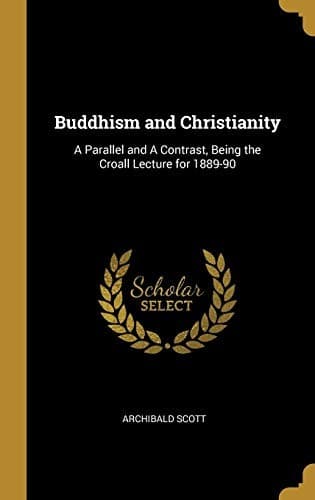
Buddhism and Christianity: A Parallel and a ContrastScott, Archibald
Religion
Buddhism and Christianity: A Parallel and a Contrast
Scott, Archibald
Buddhism -- Relations -- Christianity; Christianity and other religions -- Buddhism
This is said to be the last outcome of Brahmanic belief, and “indeed the
highest point reached by Indian philosophy.”[102] Manifestly, it can
never be designated a gospel. It was a deliverance impossible for the
many, and possible only for the few; a promise not to the suffering
millions, but to the mystic and the sage, and to them it came not with
the hope of a nobler character to be attained, and of a purer, higher
life to be reached, but only with that of a dreamless repose—“the sleep
eternal in an eternal night”—when the soul ceases to be soul, merged
“like the weariest river” in a shoreless and waveless sea. And this was
the system in which the wisest and saintliest in Buddha’s days were
nurtured. He was no Brahman by caste, but as pure Kshatrya he would be
instructed in his youth by Brahmans, and in early manhood he for long
consorted with them. He had mental capacity, and spiritual energy, more
than adequate to the task of comprehending as fully as they did their
very abstruse theosophies. From their speculation he derived much of his
terminology, like Karma and Nirvana; and even Buddha, words which, till
recently, it was considered he had to coin. Many doctrines which were
once regarded as peculiarly his own were taught in their jungle schools
by learned Brahmans centuries before he was born. Without the Brahmans
he could not have been produced, and yet his system will be found to be
original and distinct. They furnished the phraseology in which he
expressed himself, the methods by which he wrought, the institutions
like that of the wandering Bikkhu, by which his system was spread; but
in essentials we will find that his teaching was not only different from
but antagonistic to theirs, and that, had the principles which he
enunciated been truly accepted and consistently carried out, this
noblest of the Reformers of Hinduism would have reformed it out of
existence.
Public-domain text, read in full here on John Shaqi.
Reviews
Reviews
No reviews yet
Be the first to share your thoughts on this work.
Elsewhere in the archive
Join the Discussion
Join the discussion
Sign in to leave a comment or review.
Sign InorCreate an account