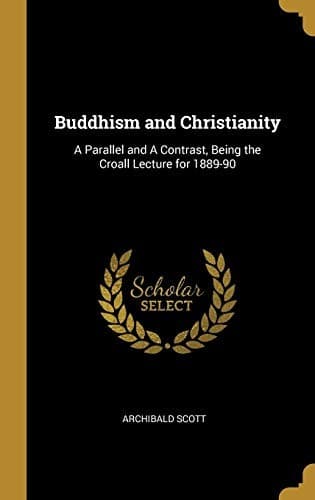
Buddhism and Christianity: A Parallel and a ContrastScott, Archibald
Religion
Buddhism and Christianity: A Parallel and a Contrast
Scott, Archibald
Buddhism -- Relations -- Christianity; Christianity and other religions -- Buddhism
The relative antiquity of the Hebrew and Indian scriptures is not a
matter which we are called upon to discuss. It is possible that some
hymns in the Rig-Veda may be older than anything which we possess in the
Bible, but it is almost absolutely certain that most of the books of the
Hebrew Bible were in circulation as scriptures, and that the whole of it
was in the shape in which we have it now, before any ancient Indian
sacred book was reduced to writing. The Pentateuch, in the form in which
we have it now, is probably not the most ancient of the Hebrew writings.
It appears to be a very composite production, containing works of
different authors, written originally at different places and at
different times. The most destructive criticism, however, admits that it
embodies very ancient traditions—many of them not peculiar to the
Hebrews,—which were open to a succession of very talented narrators.
These traditions may indicate their derivation from a once common
ancestral home, or acquirement by later contact with foreign nations,
but they are in nowise incorporations; for in the Hebrew books they are
not only presented in forms far more refined, but they are employed to
suggest or to unfold a spiritual teaching quite beyond the capacity of
the peoples among whom it is alleged they originated. No one denies that
we have in the Pentateuch writings as old as the time of Moses, and
probably fragments of writings much older still. Ewald[103] ascribes an
important portion of it to the times of the later judges, another still
more important section to a priest of Solomon’s reign, and the Book of
Deuteronomy to the time of Hezekiah. Even if we are compelled to accept
later dates than these, it follows that they are older than any
Upanishad, or even any of the Brahmanas. There was a Law, a Book of the
Covenant, a Book of Origins, in currency probably before the authors of
any of the Brahmanas was born; and even if we are to regard the contents
of these works as only traditional, we may surely assume that the Hebrew
traditions are as credible as the Indian. It is quite true “that
religion exists long before it is expressed in a canon, and that law
runs and rules long before it is written in a code,”[104] but in regard
to accuracy neither suffers from being so definitely registered.
Hitherto the maxim affecting such matters has been, and for a long time
henceforth we may be certain it will be, not _litera locuta_, but
_litera scripta manet_.
Public-domain text, read in full here on John Shaqi.
Reviews
Reviews
No reviews yet
Be the first to share your thoughts on this work.
Elsewhere in the archive
Join the Discussion
Join the discussion
Sign in to leave a comment or review.
Sign InorCreate an account