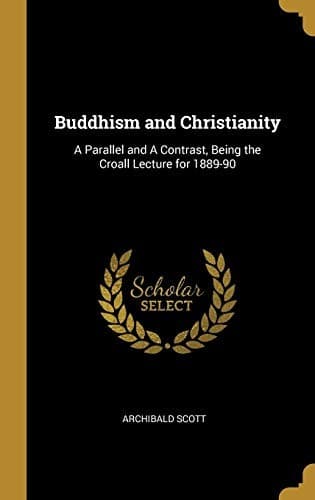
Buddhism and Christianity: A Parallel and a ContrastScott, Archibald
Religion
Buddhism and Christianity: A Parallel and a Contrast
Scott, Archibald
Buddhism -- Relations -- Christianity; Christianity and other religions -- Buddhism
which his latest descendant looked back with thankfulness.[106] We may
not be able to prove that Abraham’s conception of Deity was monotheistic
in our conception of the word. It lacked the sublimity of Isaiah’s
conception and the definiteness of that of Moses. There was naturally a
great deal of darkness clinging about it, but his ideas of duty and
religion and worship were far higher than entered the thoughts of a
Vedic or Brahmanic sage. The rite of Blood Covenant, universal in the
Semitic tribes, he felt divinely impelled to offer Godward; and the same
impulse is said to have led him to offer in proof of his allegiance to
his unseen and almighty Friend the sacrifice of his only son. But there
was unmistakably imparted by Abraham to the ancient rite of circumcision
a far higher and more spiritual idea, and it is noteworthy that while
the spiritual part of his awful sacrifice was accepted, the slaying of
the son was rejected, with the effect of stamping, in the very morning
of Hebrew history, the Divine abhorrence upon that form of propitiation
to which the unrestrained instinct of man has everywhere been prone. His
worship, his sacrifice, his whole service, instead of being regarded as
a means of making Deity serviceable to man, or of raising man to the
comfortable condition of Deity, meant the surrender of the heart and of
the whole life to His will, not as only mightier, but juster and more
merciful than he was himself, and therefore perfectly worthy of trust
and love. And so it is plain that whether the patriarchs represent a
race fallen because of sin, from purer knowledge and more intimate
communion with God, or one providentially educated from the very lowest
animalism, they indicate a religious stage to which the greatest things
became possible. They are stammering at least the glorious Name,
comprised in three letters, whose significance millennial ages of study
can never exhaust. They believe in God, who, behind and beyond Nature,
and greater than it, is revealing Himself as one infinitely worthy of
their allegiance and adoration, and their faith becomes righteousness.
Public-domain text, read in full here on John Shaqi.
Reviews
Reviews
No reviews yet
Be the first to share your thoughts on this work.
Elsewhere in the archive
Join the Discussion
Join the discussion
Sign in to leave a comment or review.
Sign InorCreate an account