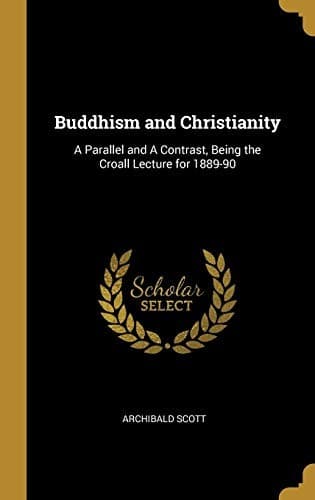
Buddhism and Christianity: A Parallel and a ContrastScott, Archibald
Religion
Buddhism and Christianity: A Parallel and a Contrast
Scott, Archibald
Buddhism -- Relations -- Christianity; Christianity and other religions -- Buddhism
Roman had trodden the nation under foot, and though the Maccabees had
suffered and poured out their blood in vain, it seemed to grow stronger
and stronger. Ready to believe any impostor, and to rise at the faintest
call, their fanaticism more than once betrayed the people into
ineffectual and most sanguinary revolts; but it had one result that was
not wholly evil, for they drew after them the multitudes to the desert,
when the thunder of the Baptist’s cry reached Jerusalem, “The kingdom of
God is at hand.”[119]
So was it in Palestine; but among the Diaspora all over the Empire the
hope of Messiah assumed a purer and more catholic form. Everywhere it
was strong, but the broader horizons by which they were surrounded saved
them from the delusions which intoxicated the Palestinian Jew. In
classical literature there are tokens that it had filtered into Gentile
minds. It was undoubtedly vague and shadowy even at its brightest, but
in the Sibyl and Pollio its fulfilment signified something more
important than a successful revolution in Palestine. It meant mighty
changes impending that would bring good to all the world, the augury of
a star that would soon glimmer in the eastern horizon, and grow and
brighten till it would be seen to be not a light for Asia only, but the
Sun of Righteousness with healing in His beams for every nation under
heaven.
We have thus been following two lines of religious movement, perfectly
independent of each other, far apart geographically, still further apart
in the beliefs which inspired them. We have seen how the melody of joy
and health which the Indians brought with them from our common primeval
home ended in a sigh of despair. Individual existence, at first so full
of wonder and delight, lost soon its freshness and glory, and came to be
felt to be such a burden that emancipation from it by absorption into
the Absolute was hailed as a boon. The human mind, leaving its childhood
behind it, and advancing to question itself and the universe, after a
season of movement and sense of freedom and power, somehow lost or
missed the way. Oppressed in the toils of the jungle, and wandering ever
further from practical life as it proceeded, it lay down vanquished,
longing only to be at rest and in quiet as infants that never saw the
light.
Public-domain text, read in full here on John Shaqi.
Reviews
Reviews
No reviews yet
Be the first to share your thoughts on this work.
Elsewhere in the archive
Join the Discussion
Join the discussion
Sign in to leave a comment or review.
Sign InorCreate an account