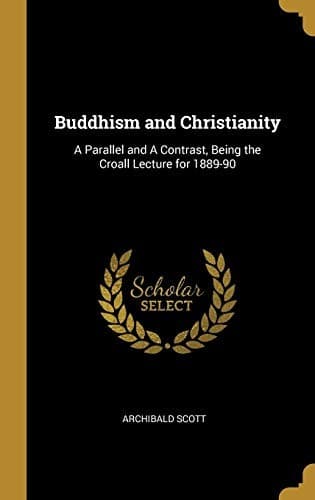
Buddhism and Christianity: A Parallel and a ContrastScott, Archibald
Religion
Buddhism and Christianity: A Parallel and a Contrast
Scott, Archibald
Buddhism -- Relations -- Christianity; Christianity and other religions -- Buddhism
Professor Max Müller, Introd. to Dhammapada, _Sacred Books of the
East_, vol. x. p. x.
Footnote 72:
_Sacred Books of the East_, vol. xiii. p. 37; Introd., vol. xi. p. xx.
Footnote 73:
Oldenberg, _Buddha, etc._, p. 27.
Footnote 74:
Mahavansa, by Turnour; Dipavansa, xx. 20, quoted by Professor Max
Müller in _Sacred Books of the East_, vols. x. p. xxiv, and xiii. p.
xxxv.
Footnote 75:
_Buddhist Birth Stories_, vol. i. p. lvii; Trübner’s Oriental Series.
Footnote 76:
Weber, _Indian Literature_, p. 294; _ibid._
Footnote 77:
We may safely assert that in the mass of Buddhist literature already
available nothing has been found, nor is anything at all likely to be
found, corresponding in character and evidential value to the
Christian Scriptures. What would the New Testament have been, asks
Professor Müller, “if the spurious Gospels, the pseudo-apostolic and
post-apostolic productions, the debates of the Councils, the
commentaries of the Fathers, and the lives of the saints, had all been
bound and mixed up with it”? (_Sacred Books of the East_, vol. i.,
Introd., pp. xv, xvi.) And yet this is a parallel to the confusion
represented by the so-called Buddhist Bible. In truth, it is not a
Bible, but a library, containing not only the earliest treatises, but
the commentaries upon them made in later ages, and extracts and
repetitions from itself so extensive and numerous that were they
omitted this portentous collection—four times as voluminous as our
Christian Bible—would be found to be much shorter than it. When the
original Bible of Buddhism has been disinterred from this pile it will
be found to resemble almost in nothing our New Testament, but it may
present many analogies to the Talmud and Targums, and perhaps some
very interesting resemblances to isolated portions of the Old
Testament. As far as it has been translated to us, the Tripitaka
contain neither prophecy nor history; but one division of it presents
suggestive coincidences with portions of the apocryphal Scriptures;
and scholars may find a comparison of some of the texts of Job,
Proverbs, and Ecclesiastes with those of the Dhammapada and some of
the Suttas an agreeable and not unprofitable study, without in the
least being tempted to transfer their allegiance from the Hebrew to
the Indian sages.
Footnote 78:
Eitel, _Lectures on Buddhism_, p. 6; Hunter, “Historical Aspects of
Indian Geography,” _Scot. Geog. Mag._, Dec. 1888.
Footnote 79:
Rogers, _Superhuman Origin of the Bible_, Lecture v.
Footnote 80:
Professor Max Müller, _Introduction to the Science of Religion_, p.
103.
Footnote 81:
Professor Müller, Gifford Lectures, _Natural Religion_, p. 564.
Footnote 82:
_Record of Missionary Conference in London_, 1888, vol. i. p. 39; also
his _Buddhism_, p. 558.
Footnote 83:
_Le Génie des Religions._
Footnote 84:
Public-domain text, read in full here on John Shaqi.
Reviews
Reviews
No reviews yet
Be the first to share your thoughts on this work.
Elsewhere in the archive
Join the Discussion
Join the discussion
Sign in to leave a comment or review.
Sign InorCreate an account