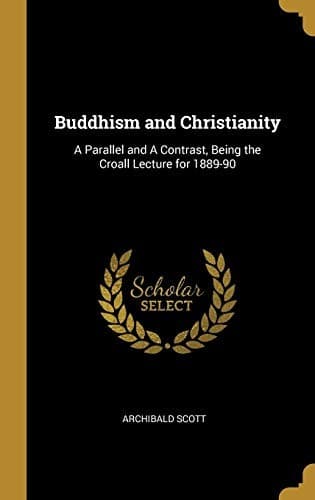
Buddhism and Christianity: A Parallel and a ContrastScott, Archibald
Religion
Buddhism and Christianity: A Parallel and a Contrast
Scott, Archibald
Buddhism -- Relations -- Christianity; Christianity and other religions -- Buddhism
For again, Christ conquered because from the beginning to the closing
agony He stood firm rooted in obedience and in submission to the will of
a Higher than self; but the Buddhist writers want to impress the very
opposite of this upon us in regard to Gotama’s victory. He is said to
have conquered Mâra by the force of his own will, and won his way to
light by his individual energy alone. After he became Buddha he
hesitated whether he would preach the way of deliverance to men, not
because, like Moses and the Hebrew prophets, he had no confidence in
himself and required the assurance of a divine strength not his own. He
had perfect assurance in himself, but he had no confidence at first in
the ability of others to comprehend and to follow him in a way so
difficult to find and so hard to tread.[139] He asked no deity to help
him, for he was greater and wiser than all the gods. In the legends
Brahma is said in intercession to have pressed him to preach the way,
and moved eventually by no intercession, but simply by his own pity for
men lost in the vortices of miserable existence, he went forth in no
strength but his own to preach and to teach in a ministry, not of shame
and humiliation and death, but one of great exaltation and honour.
This conception colours the narrative of his whole career. In the later
scriptures he is designated the Tathâgata (He who has gone or arrived at
Nirvana), the very reverse and point-blank contradiction of Christ the
Messiah, He who was sent. There was no higher to send him, no wiser to
teach. He came in his own name; but Jesus, as one sent by Him into the
world, went forth in the name of His Father. Though He made demands upon
the faith of the world compared with which the pretensions of Gotama are
trivial—for at the highest he only claimed to be Buddha the Enlightened,
while Christ spake of Himself as the “Light of the world,”—yet in
Christ’s claim there was ever a sense of dependence expressed or
implied, as of one who of His own self could do nothing, and who only
taught what His Father had showed Him. Both spake with authority, and
not as the scribes; both superseded the traditional domination of what
was said by men of old times with the emphatic “I say unto you”; but
there is a vast difference in the quality of this authority in the two
cases. The authority of Buddha sprang from his acknowledged intellectual
superiority, but the authority of Jesus sprang from spiritual insight.
The deliverances of Buddha were given after the manner of a Socratic
dialogue, and he won his converts and vanquished opponents by his
dialectic skill.[140] But in all the encounters of Christ with His
enemies there was no forcing of their reason to gain His end. His
replies and counter questions were brief and direct and incisive; they
were like the fiat of a king or the sentence of an unchallengeable
judge, from which reason and conscience alike confessed that there could
be no appeal.
Public-domain text, read in full here on John Shaqi.
Reviews
Reviews
No reviews yet
Be the first to share your thoughts on this work.
Elsewhere in the archive
Join the Discussion
Join the discussion
Sign in to leave a comment or review.
Sign InorCreate an account