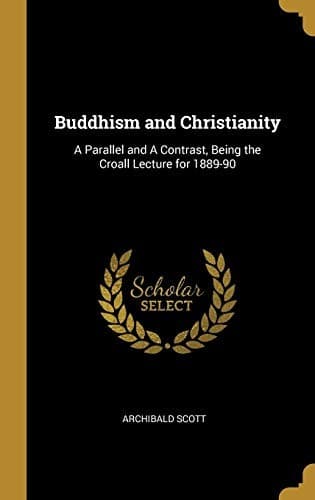
Buddhism and Christianity: A Parallel and a ContrastScott, Archibald
Religion
Buddhism and Christianity: A Parallel and a Contrast
Scott, Archibald
Buddhism -- Relations -- Christianity; Christianity and other religions -- Buddhism
Then he would tell how when he set “a-rolling the wheel” of the “kingdom
of righteousness,”[151] he did so with such effect that not only
multitudes of men, but eighty thousand gods and angels, “hearing, each
in their own tongue, though the language was that of Magadha,”[152] were
by one sermon imbued with saving knowledge and converted; how during his
long and holy ministry, by discourses and parables and miracles, he
brought countless millions of men and women, and gods and sprites and
fairies, to find the right way; how the great devas came to worship or
to ask counsel from him;[153] how, inviolable and invincible, there
could not be found, either in this world or in the world of the devas,
Mâras, Brahmans, “any who could either scatter his thoughts or cleave
his heart”;[154] how he was transfigured,[155] and at last, when the
time was come, accompanied by a disciple very dear to him, how he lay
down like a king between two trees. Then when winds were hushed, and
streamlets silenced, and flowers from heaven shed their blossoms over
him like rain-drops, and a great earthquake rumbled, and the sun and
moon hid their faces, and the great Brahma lamented, rising through
light to light he achieved the full Nirvana.[156]
It is not wonderful that Christians who have only read or heard of the
statements current as to the remarkable coincidences between the
miraculous incidents recorded in the Buddhist legends and the Christian
Gospels should be perplexed, and that not a few of those who are
anti-Christian in their attitude should have almost jumped to the
conclusion that the biographers of the two lives must have known of each
other’s works and borrowed each other’s traditions. Examination of the
alleged coincidences, however, reveals that there is no occasion for the
perplexity in the one case, and no ground for the jubilation in the
other. By no honest process of manipulation can we turn the supposed
similarities into even probable identities. The incidents illustrate
very widely contrasted lives, and enforce dogmas utterly contradictory
to each other. If any one is desirous of ascertaining the coincidences
which are stated to exist, he will find them clearly set forth and
classified by Professor Seydel in his so-called Buddhist Harmony;[157]
and if he require any more than his own common sense to guide him to an
opinion concerning them, he had better consult the Appendix to Professor
Kuenen’s Hibbert Lectures on _National Religions and Universal
Religions_, Dr. Kellogg’s _Light of Asia and Light of the World_, and
Dr. J. Estlin Carpenter’s article in the _Nineteenth Century_, December
1880, “On the Obligations of the New Testament to Buddhism.” These
authorities will confirm the judgment which any unbiassed and
intelligent juryman would form, from considering the evidence adduced in
support of the theory of borrowing, and from a simple comparison of the
alleged parallels themselves, that Buddhism had not the smallest direct
Public-domain text, read in full here on John Shaqi.
Reviews
Reviews
No reviews yet
Be the first to share your thoughts on this work.
Elsewhere in the archive
Join the Discussion
Join the discussion
Sign in to leave a comment or review.
Sign InorCreate an account