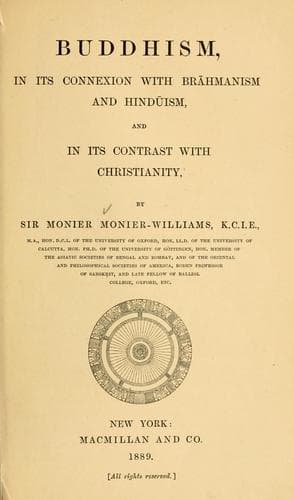
Buddhism, in Its Connexion with Brahmanism and Hinduism, and in Its Contrast with ChristianityMonier-Williams, Monier, Sir
Religion
Buddhism, in Its Connexion with Brahmanism and Hinduism, and in Its Contrast with Christianity
Monier-Williams, Monier, Sir
Buddhism; Buddhism -- Relations -- Christianity; Christianity and other religions -- Buddhism; India -- Religion
Sometimes, however, this Ādi-Buddha is said to have produced all things
through union with Prajñā (mentioned before, p. 202), in which case he
is rather to be identified with the personal Creator Brahmā.
Observe, moreover, that even in early times one of the
Dhyāni-Buddhas—the one called Amitābha, ‘diffusing infinite light,’—lost
his purely abstract character, and was worshipped by Northern Buddhists
as a personal God. He is in the present day held by them to be an
eternal Being, the ideal of all that is beautiful and good, who receives
his worshippers into a heaven called Sukhāvati, ‘paradise of pleasures’
(see p. 183).
But it must also be noted that neither Ādi-Buddha nor Amitābha, when
regarded as personal gods, were held to be Creators of the World in the
Christian sense. They were merely Supreme rulers outside and above it;
for Northern Buddhists agree with Southern in thinking that the world
exists of itself, and that its only Creator is the force of its own
acts.
We pass on now to consider how far and with what modifications the
mythology of Brāhmanism and Hindūism was incorporated into Buddhism.
I have already pointed out that although the Buddha changed the
character of much of the existing mythology, he never prohibited his
lay-followers from continuing their old forms of worship, or bowing down
before the deities honoured by their fathers and grandfathers.
Apart indeed from the shrewd policy of not assuming an attitude of
hostility to popular creeds and usages, the tolerant tendency and
universality of the Buddha’s teaching obliged him, in common
consistency, to recognize, and as far as possible appropriate, the
various religious elements existing around him, and to subordinate them
to his own purposes.
In fact, according to the theory of true Buddhism, as has been well
pointed out by other writers, there was only one system of doctrine and
only one Law—that Law (Dharma) which Gautama Buddha came to renovate for
the benefit of the world in the present age.
Hence all the apparently conflicting creeds, dogmas, forms, ceremonies,
and usages of all nations, tribes, and races, were in reality mere
outcomes, or dim recollections, or corruptions, of that one and the same
universal Dharma which countless Buddhas had preached to mankind, in
countless ages before the time of Gautama, and would continue to preach
in ages to come.
Hindūism, therefore, like all other creeds, was contained in the Dharma
of Buddhism, and the great object of Gautama’s advent was not to uproot
the old religion, but to purify it from error and restore it.
It was on this account that he regarded the Hindū gods as occupying a
place in his own system, though not without some modification of the
nature of their supposed position, offices, and functions.
And here it will be necessary to give an account of the later Buddhist
theory of twenty-six successive tiers of heavens, one rising above the
other (p. 120).
Public-domain text, read in full here on John Shaqi.
Reviews
Reviews
No reviews yet
Be the first to share your thoughts on this work.
Elsewhere in the archive
Join the Discussion
Join the discussion
Sign in to leave a comment or review.
Sign InorCreate an account