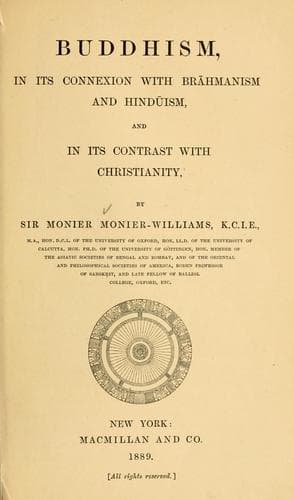
Buddhism, in Its Connexion with Brahmanism and Hinduism, and in Its Contrast with ChristianityMonier-Williams, Monier, Sir
Religion
Buddhism, in Its Connexion with Brahmanism and Hinduism, and in Its Contrast with Christianity
Monier-Williams, Monier, Sir
Buddhism; Buddhism -- Relations -- Christianity; Christianity and other religions -- Buddhism; India -- Religion
We read in the Lalita-vistara (chap. i) that at the supreme moment of
his intellectual illumination brilliant flames of light issued from the
crown of his head, through the interstices of his cropped hair. These
rays are sometimes represented in his images, emerging from his skull in
a form resembling the five fingers of an extended hand (see the
frontispiece).
Mark, however, that Gautama’s meditation never led him to the highest
result of the true Yoga of Indian philosophy—union with the Supreme
Spirit. On the contrary, his self-enlightenment led to entire disbelief
in the separate existence of any eternal, infinite Spirit at all—any
Spirit, in fact, with which a spirit existing in his own body could
blend, or into which it could be absorbed.
If the Buddha was not a materialist, in the sense of believing in the
eternal existence of material atoms, neither could he in any sense be
called a ‘spiritualist,’ or believer in the eternal existence of
abstract spirit.
With him Creation did not proceed from an Omnipotent Spirit or Mind
evolving phenomena out of itself by the exercise of will, nor from an
eternal self-existing, self-evolving germ of any kind. As to the
existence in the Universe of any spiritual substance which was not
matter and was imperceptible by the senses, it could not be proved.
Nor did he believe in the eternal existence of an invisible Self or Ego,
called Soul, distinct from a material body. The only eternity of true
Buddhism was an eternity of ‘becoming,’ not of ‘being’—an eternity of
existences, all succeeding each other, and all lapsing into nothingness.
If there were any personal gods they were all inferior to the perfect
man, and all liable to change and dissolution.
In brief, the Buddha’s enlightenment consisted, first, in the discovery
of the origin and remedy of suffering, and, next, in the knowledge of
the existence of an eternal Force—a force generated by what in Sanskṛit
is called Karman, ‘Act.’ The accumulated force of the acts of one
Universe produced another.
Every man, therefore, was created by the force of his own acts in former
bodies, combined with a force generated by intense attachment to
existence (upādāna). Who or what started the first act, the Buddha never
pretended to be able to explain. He confessed himself in regard to this
point a downright Agnostic. The Buddha himself had been created by his
own acts, and had been created and re-created through countless bodily
forms; but he had no spirit or soul existing separately between the
intervals of each creation. By his protracted meditation he attained to
no higher knowledge than this, and although he himself rose to loftier
heights of knowledge than any other man of his day, he never aspired to
other faculties than were within the reach of any human being capable of
rising to the same sublime abstraction of mind.
Public-domain text, read in full here on John Shaqi.
Reviews
Reviews
No reviews yet
Be the first to share your thoughts on this work.
Elsewhere in the archive
Join the Discussion
Join the discussion
Sign in to leave a comment or review.
Sign InorCreate an account