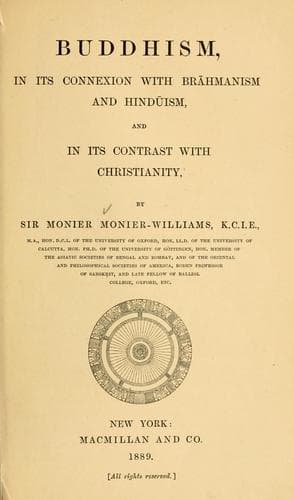
Buddhism, in Its Connexion with Brahmanism and Hinduism, and in Its Contrast with ChristianityMonier-Williams, Monier, Sir
Religion
Buddhism, in Its Connexion with Brahmanism and Hinduism, and in Its Contrast with Christianity
Monier-Williams, Monier, Sir
Buddhism; Buddhism -- Relations -- Christianity; Christianity and other religions -- Buddhism; India -- Religion
His followers of the Yellow school called themselves Gelugpa (or
Gelukpa), ‘adherents of virtue’ (or, Gal-danpa from their monastery);
their principal characteristic being that they adhered to the purer
discipline.
The chief point of interest in connexion with Tsong Khapa is the bearing
of his reformation on the development of the Avatāra theory already
mentioned (see pp. 190, 265).
It is said that Tsong Khapa himself, like Gautama Buddha, had two chief
pupils, and that he appointed these two to succeed him with equal
authority as Heads of the orthodox sect. He is also credited with having
been the first to promulgate the doctrine that no election of successors
to his two pupils would at any time be needed, as each of them on dying
would be constantly re-born in a supernatural manner.
There is, however, no historical foundation for such a statement.
Indeed, according to the opinion of some, the two Grand Lāmas were
merely the lineal successors of the two eminent Lāmas, Atīsha and his
pupil Brom Ton (see p. 273).
After all, it seems most likely that the whole Avatāra theory was an
invention of some shrewd Head Lāma, who, perceiving that the strict
enforcement of celibacy would prevent any hereditary succession, like
that possible in monasteries of the Red school, and foreseeing that it
would be necessary to prevent the suicidal divisions to which the
intrigues of an election to the Headship of monasteries—especially of
Grand Lāma monasteries—would be likely to give rise, bethought himself
of a compromise between hereditary succession and election. After more
than one trial, the system was found to work so well that it was
eventually adopted with little modification by all Northern Buddhists,
and even by those of the Red sect.
The date of its invention is as uncertain as the name of the inventor.
All that can be said is, that it cannot be traced back to an earlier
period than the fifteenth century.
And here we must again guard against the confusion of thought likely to
arise from the usual practice of translating Avatāra by ‘incarnation.’
We have seen that the doctrine of transmigration (gati) through various
embodiments, as applicable to all beings, is a fundamental dogma both of
Brāhmanism and of Buddhism, though in Buddhism transmigration properly
means a mere continuous transformation and reconstruction of the
elements (Skandhas) of being (p. 109).
The idea is very dimly, if at all, adumbrated in the Mantra portion of
the Veda.
It is more clearly traceable in one of the Brāhmaṇas, and distinctly
enunciated in the Ćhāndogya Upanishad (V. x. 7) thus:—‘He whose conduct
has been good, quickly attains to some good embodiment as a Brāhman,
Kshatriya, or Vaiṡya. He whose conduct has been bad, assumes an inferior
embodiment, as a dog, a hog, or a Ćaṇḍāla.’ In Manu the theory is fully
developed.
Public-domain text, read in full here on John Shaqi.
Reviews
Reviews
No reviews yet
Be the first to share your thoughts on this work.
Elsewhere in the archive
Join the Discussion
Join the discussion
Sign in to leave a comment or review.
Sign InorCreate an account