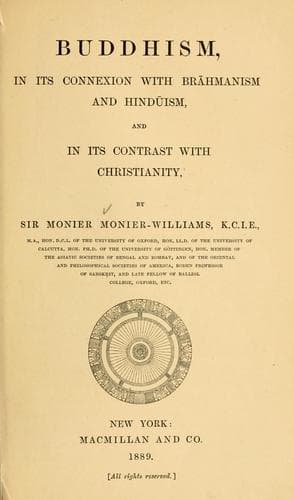
Buddhism, in Its Connexion with Brahmanism and Hinduism, and in Its Contrast with ChristianityMonier-Williams, Monier, Sir
Religion
Buddhism, in Its Connexion with Brahmanism and Hinduism, and in Its Contrast with Christianity
Monier-Williams, Monier, Sir
Buddhism; Buddhism -- Relations -- Christianity; Christianity and other religions -- Buddhism; India -- Religion
Passing on to Nepāl—this country probably adopted Buddhism before the
beginning of the Christian era. It is said that Aṡoka’s missionaries
found their way there; but there is no proof that Buddhism really
flourished in Nepāl till the seventh century, and even then it never
existed except in conjunction with Brāhmanism. It is probable that
Buddhist monasteries and Brāhmanical temples always adjoined each other.
Indeed since the immigration of the Hindūs into Nepāl, and especially
since the invasion of the Gorkhas, there have always been two
nationalities, two languages, two literatures, two religions in contact
with each other.
In recent times Brāhmanism has gained the predominance as the
State-religion, and Buddhism has degenerated, though it is everywhere
tolerated.
It is a question whether the spiritual supremacy of the Tibetan Grand
Lāma has ever been acknowledged in Nepāl proper. But, according to some,
the Dalai Lāma formerly had a legate or representative in the largest
and oldest Buddhistic temple of Khatmandu—the temple of Svayambhu-nāth,
who is here at once Ādi-Buddha and Ṡiva. The Dalai Lāma also claimed the
ownership of this temple, which, he maintained, had been dependent on
him from the earliest times. But it is certain that, even if the Tibetan
Legate ever possessed the authority arrogated by him, he was compelled
by the Gorkhas to abandon his claims. Nevertheless the Tibetan tribes
now in Nepāl still adhere to Buddhism. The same may be said of the
Newars, who are the original possessors of the great valley of Nepāl.
They profess a kind of Buddhism, though they reject the Lāmas, and have
priests of their own, whom they call Bandya (see note p. 263).
With regard to Bhutān (capital town Punakha) it is said to have become
Buddhist about 350 years ago. Its spiritual ruler and incarnated saint
is called Dharma-rāja (or Lāma Rinpoche). He belongs to the Red-cap
school, and calls himself Chief of all the monks of the Dugpa sect. His
subordination to the Dalai Lāma is little more than nominal. The
temporal Governor is called Depa-rāja (Deb-rāja).
The following titles engraved on the Dharma-rāja’s seal of office will
give some idea of his pretensions:—
‘I am the Chief of the realm. Defender of the Faith. Equal to Sarasvatī
in learning. Chief of all the Buddhas. Head-expounder of the Ṡāstras.
Caster out of devils. Most learned in the holy Laws. An Avatār of God.
Absolver of sins. Head of the best of all religions.’ (See Dr. Wright’s
Nepāl.)
It is said that there are about 10,000 monks, and about 50,000 Buddhist
lay families in Bhutān. Many of the monks do not live in monasteries,
but hold offices under the Government.
Public-domain text, read in full here on John Shaqi.
Reviews
Reviews
No reviews yet
Be the first to share your thoughts on this work.
Elsewhere in the archive
Join the Discussion
Join the discussion
Sign in to leave a comment or review.
Sign InorCreate an account