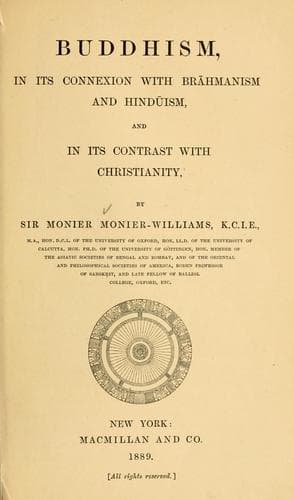
Buddhism, in Its Connexion with Brahmanism and Hinduism, and in Its Contrast with ChristianityMonier-Williams, Monier, Sir
Religion
Buddhism, in Its Connexion with Brahmanism and Hinduism, and in Its Contrast with Christianity
Monier-Williams, Monier, Sir
Buddhism; Buddhism -- Relations -- Christianity; Christianity and other religions -- Buddhism; India -- Religion
On their return from their perambulation a portion of the food is
offered to the Buddha, and then all proceed to eat the remainder,
consisting perhaps of cooked rice, boiled peas, fish, cocoa-nut cakes,
cucumbers, or even curried flesh and fowl, usually wrapped separately in
plantain-leaves. Next the bowls are washed, and a few hymns are chanted
before the Buddha’s image. During the succeeding hour the boy-scholars
are allowed to play about, while the monks pass their time in
conversation, and the Abbot receives people who come to pay their
respects. All visitors prostrate themselves before him three times, once
for the Buddha, once for the Law, and once for the Monkhood. The Abbot
in return says: ‘May the supporter’ (so he calls all laymen; compare p.
89), ‘as a reward for merit, be freed from the three calamities (of war,
pestilence, and famine)!’ At about half-past eleven the last regular
meal of the day is eaten. Monks are forbidden to eat after noon. When
the mid-day meal is over, all return to work. Some undertake the
teaching of the boy-scholars. Others read the texts of the Tri-piṭaka
with their commentaries, or superintend the writers who are copying
manuscripts. Some of the older members of the monastery talk with the
idlers, who are to be found lounging about the precincts, and some sink
into deep meditation, which probably ends in deep sleep.
Yet this profound meditation is believed to be all important, for is it
not the path to Arhatship, to Nirvāṇa, and to the acquisition of
supernatural faculties (see p. 245)? Other monks tell the beads of their
rosaries and repeat the prescribed formularies, such as: ‘All is
changeful, all is sorrowful, all is unreal,’ followed by invocations to
the three holies (see p. 175). Between three and four o’clock the
lessons are finished, and the scholars perform any domestic duties
required in the monastery. This is the chief return for the teaching
they receive. Then most of the pupils go to their own homes for dinner.
As to the youthful novices or junior monks, these are all obliged to
fast like the full monks. Many of them go out with some of the senior
monks for a solemn walk. Then at sunset the far-reaching notes of the
bell summon the walkers back to the monastery. All must be within the
walls before the sun goes down. The day’s duties now draw to a close.
The boy-pupils are made to repeat all they have learned during the day,
and some of the Pāli rituals are chanted ‘with spasmodic energy.’ At
half-past eight or nine there are further recitations before the image
of the Buddha. All assemble, as in the morning, and together intone the
hymns. When the last sound of the chant has died away, one of the
novices stands up and proclaims the hour, day of the week, day of the
month, and number of the year. Then all bow before the Buddha’s image,
and thrice before the Head of the monastery, and retire to rest (see
Shway Yoe’s ‘Burman’).
Public-domain text, read in full here on John Shaqi.
Reviews
Reviews
No reviews yet
Be the first to share your thoughts on this work.
Elsewhere in the archive
Join the Discussion
Join the discussion
Sign in to leave a comment or review.
Sign InorCreate an account