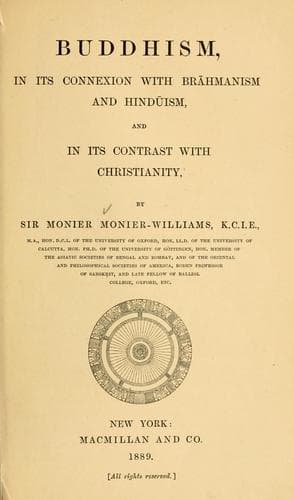
Buddhism, in Its Connexion with Brahmanism and Hinduism, and in Its Contrast with ChristianityMonier-Williams, Monier, Sir
Religion
Buddhism, in Its Connexion with Brahmanism and Hinduism, and in Its Contrast with Christianity
Monier-Williams, Monier, Sir
Buddhism; Buddhism -- Relations -- Christianity; Christianity and other religions -- Buddhism; India -- Religion
Then at other times a sentence of the Law is repeated by each monk in
turn; or a chant is set up consisting of such words as: Praise be to the
Buddha! or praise be to some Bodhi-sattva! followed by a recital of all
his names, titles, and epithets; or mystical sentences and syllables are
ejaculated. The result is said to be a chaos of voices and a deafening
confusion of sounds.
The chief instruments used in the services are a spiral shell, a long
trumpet of copper or brass (sometimes more than ten feet long), a large
drum, flutes, cymbals, and horns—the last being sometimes made of the
thigh-bones of human beings[145].
The ritual is imposing, and still more so when a living Buddha is
present. It has been described by M. Huc, and I here give the substance
of his account[146].
In front of the chief idol, and on a level with the altar, is a gilded
seat for the living Buddha or Grand Lāma of the Monastery. The whole
space of the temple, from one end to the other, is occupied by long
low seats almost level with the ground, stretching right and left of
the Grand Lāma’s throne. These are covered with carpets, a vacant
space being left between each row for the Lāmas to pass and repass.
When the hour of prayer is come, a Lāma, whose office it is to summon
the choir, places himself in front of the grand entrance of the temple
and blows with all the force of his lungs into a conch-shell trumpet,
the sound of which is audible for a league round. This effectually
rouses the Lāmas and calls them together. Each then takes his mantle
and official hat of ceremony, and repairs to the interior court. The
trumpet sounds again, and when its note is heard for the third time,
the great door is suddenly thrown open; the living Buddha enters, and
takes his seat in front of the image on the altar. Then the Lāmas,
after depositing their red boots in the vestibule, advance towards him
barefoot, and adore him by three prostrations. This done, they seat
themselves on the long seats according to their dignity, cross-legged
and face to face. As soon as the director of the ceremonies has given
the signal by tinkling a little bell, everyone murmurs the prescribed
prayers, unrolling the formularies on his knees. After this
recitation, there is profound silence for a minute. Then the bell is
again rung, and a hymn or chant in two choruses begins. The Tibetan
prayers, ordinarily arranged in verses, and written in metrical style,
are well adapted to harmony; but sometimes at certain pauses indicated
by the rubric, the Lāma musicians execute a strain in little accord
with the gravity of the psalmody. The result is a stunning noise of
bells, cymbals, drums, tambourines, conch-shells, trumpets, and pipes.
Each musician sounds his instrument with a sort of fury, and each
strives to outdo his neighbour in the noise he can produce. (Huc’s
Travels, i. 88, abridged.)
Public-domain text, read in full here on John Shaqi.
Reviews
Reviews
No reviews yet
Be the first to share your thoughts on this work.
Elsewhere in the archive
Join the Discussion
Join the discussion
Sign in to leave a comment or review.
Sign InorCreate an account