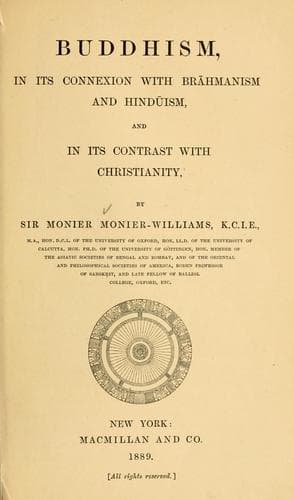
Buddhism, in Its Connexion with Brahmanism and Hinduism, and in Its Contrast with ChristianityMonier-Williams, Monier, Sir
Religion
Buddhism, in Its Connexion with Brahmanism and Hinduism, and in Its Contrast with Christianity
Monier-Williams, Monier, Sir
Buddhism; Buddhism -- Relations -- Christianity; Christianity and other religions -- Buddhism; India -- Religion
This is doubtless a true comparison. But it does not follow that the
opinion which the missionaries express—‘that these analogies are of
Christian origin’—is equally deserving of our assent. No doubt one chief
feature of Buddhism, as of Hindūism[158], is its receptivity, but may it
not be the case that human nature and human tendencies will be found to
assert themselves independently in every part of the world, wherever
surrounding circumstances are favourable to their development?
LECTURE XIII.
_Festivals, Domestic Rites, and Formularies of Prayer._
We must now turn to the consideration of some of the chief festivals,
domestic rites, and prayer-formularies of Buddhism—a subject which
follows as a natural sequel to the last Lecture.
It is well known that the Hindūs have certain festivals and holy days,
celebrated at the junction of the seasons which in India are properly
six in number—namely, spring, summer, the rains (Varsha), autumn,
winter, and the season of dew and mist (see ‘Indian Wisdom,’ p. 450;
‘Brāhmanism and Hindūism,’ p. 428).
Buddhism has adopted the old Hindū ideas on this subject, and has added
others of its own, but generally only reckons three seasons—summer, the
rains (Vassa = Varsha) and winter.
The festival of the New Year is, of course, universal. It is supposed to
celebrate the victory of light over darkness, and, in Buddhist
countries, of Buddhism over ignorance. The corresponding Hindū festival
is called Makara-saṅkrānti. In India this marks the termination of the
inauspicious month Pausha and the beginning of the sun’s northern course
(uttarāyaṇa) in the heavens. It is a season of general rejoicing.
In Burma, where a good type of Southern Buddhism is still to be found,
the New Year’s festival might suitably be called a ‘water-festival.’ It
has there so little connexion with the increase of the New Year’s light,
that it often takes place as late as the early half of April (see Mr.
Scott’s ‘Burman,’ ii. 48). It is, however, a movable feast, the date of
which is regularly fixed by the astrologers of Mandalay, ‘who make
intricate calculations based on the position of various constellations.’
The object is to determine on what precise day the king of the Naths
(see p. 217 of this volume) will descend upon the earth and inaugurate
the new year. When the day arrives all are on the watch, and just at the
right moment—which invariably occurs at midnight—a cannon is fired off,
announcing the descent of the Nath-king upon earth. Forthwith (according
to Mr. Scott) men and women sally out of their houses, carrying pots
full of water consecrated by fresh leaves and twigs of a sacred tree (p.
514 of this volume), repeat a formal prayer, and pour out the water on
the ground. At the same time all who have guns of any kind discharge
them, so as to greet the new year with as much noise as possible.
Public-domain text, read in full here on John Shaqi.
Reviews
Reviews
No reviews yet
Be the first to share your thoughts on this work.
Elsewhere in the archive
Join the Discussion
Join the discussion
Sign in to leave a comment or review.
Sign InorCreate an account