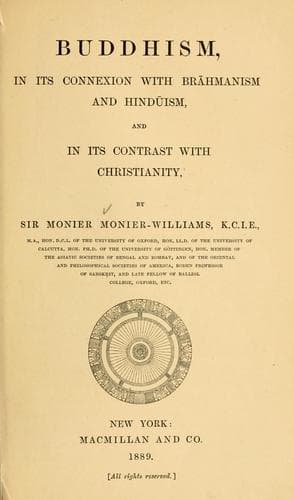
Buddhism, in Its Connexion with Brahmanism and Hinduism, and in Its Contrast with ChristianityMonier-Williams, Monier, Sir
Religion
Buddhism, in Its Connexion with Brahmanism and Hinduism, and in Its Contrast with Christianity
Monier-Williams, Monier, Sir
Buddhism; Buddhism -- Relations -- Christianity; Christianity and other religions -- Buddhism; India -- Religion
I was fortunate enough to meet with a remarkable specimen of a magical
weapon of this kind (called Phur-pa by Jäschke) made of metal, and
shaped like a dagger with three edges, one for each of the three classes
of demons inhabiting the three quarters. The handle is composed of a
Dorje (p. 322), and is surmounted by carvings of the heads of the three
most powerful Dragsheds. I here give a representation of it[161].
[Illustration: ]
It may be easily understood that among a people, steeped in
superstition, a man armed with such a weapon as this—composed of the
heads of three potent genii, a divine thunderbolt and a triple-edged
dagger—would be regarded as a match for the whole demon-host.
In Burma the tattooing of mystical squares, triangles and cabalistic
diagrams and figures on various parts of the body, seems to be regarded
as a sufficient substitute for the use of magical weapons, and is held
to be highly efficacious.
Obviously we may contrast the Christian armoury described by S. Paul
(Ephes. vi. 11), ‘the shield of faith and the sword of the Spirit.’ We
might also contrast the words of Christ, ‘Rejoice not, that the spirits
are subject unto you; but rather rejoice, because your names are written
in heaven’ (S. Luke x. 20).
_Domestic Rites and Usages._
I now pass on to domestic rites and usages, which are as numerous and
important in Buddhist countries as in India. It is said, indeed, that in
Tibet and Mongolia no one is so poor as not to possess an altar in his
dwelling on which he daily lays his offerings, and before which he
performs devotions.
In Ceylon and Burma certain ceremonies take place soon after the birth
of a child. Mr. Scott, describing those in Burma, says that a fortnight
after birth a fortunate day and hour is fixed by an astrologer for the
naming of the infant. A feast is prepared, and all the friends and
relations of the family are invited. ‘The child’s head is usually washed
for the first time on this day,’ and some one suggests a name.
The name actually given appears to be a matter of choice, but this is
not so. The consonants of the language are divided into groups, which
are assigned to the days of the week, Sunday having all the vowels to
itself. ‘It is an invariable rule in all respectable families that the
child’s name must begin with one of the letters belonging to the day on
which it was born, but within these limits any name may be chosen.’ A
common belief is that, according to the day of the week (or rather the
constellation representing that day) on which a child is born, so will
its character be.
In this way every person’s probable characteristics may be inferred. For
example, a man born on a Monday is likely to be jealous; on Tuesday,
honest; on Wednesday, hot-tempered—but soon appeased—this characteristic
being intensified under the influence of Rāhu[162].
Public-domain text, read in full here on John Shaqi.
Reviews
Reviews
No reviews yet
Be the first to share your thoughts on this work.
Elsewhere in the archive
Join the Discussion
Join the discussion
Sign in to leave a comment or review.
Sign InorCreate an account