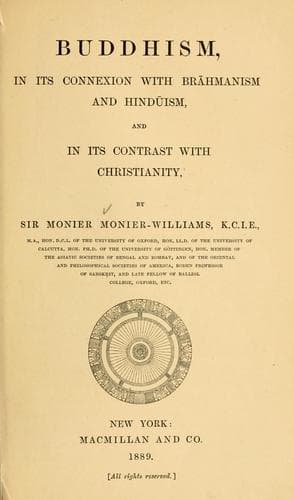
Buddhism, in Its Connexion with Brahmanism and Hinduism, and in Its Contrast with ChristianityMonier-Williams, Monier, Sir
Religion
Buddhism, in Its Connexion with Brahmanism and Hinduism, and in Its Contrast with Christianity
Monier-Williams, Monier, Sir
Buddhism; Buddhism -- Relations -- Christianity; Christianity and other religions -- Buddhism; India -- Religion
In Ceylon, when any one is dangerously ill, the monk-priest is summoned
from the neighbouring Vihāra, after first sending offerings of flowers,
oil, and food. Then a temporary preaching-place is erected near the
house, and all the relatives and friends, and if possible the sick man
himself, listen to the reading of the Law (Baṇa) for about six hours.
The part especially read and intoned is the Ratna-valiya section of the
Pirit (see p. 317). After the Baṇa a number of offerings are given to
the reciting priest, including a piece of calico, one end of which is
held by the priest, and the other by the sick man. Then the priest
pronounces a benediction, and says words to the following effect:—‘By
reverence do the wise secure health, by almsgiving do they lay up
treasures for themselves[169].’
When the sick man is likely to die the priest repeats the Three-refuge
formula (p. 78), the five commandments (p. 126), and the Sati-paṭṭhāna
Sutta (p. 49).
In Burma, if an epidemic happens to break out in any village, the people
begin by painting the supposed figure of an evil spirit on a common
earthenware water-pot, and then solemnly smashing it to pieces at sunset
with a heavy stick[170]. Then as soon as it gets dark all the villagers
shout, yell, shriek, and make every kind of deafening din, with the hope
of frightening away the evil spirit who has caused the disease. This
process is continued for three nights, and if no good result follows the
monk-priests are called in from the monastery. They recite the ten
precepts, chant the Law up and down the road, and intone a particular
sermon of the Buddha, by the preaching of which he once drove away a
pestilence. These means are, of course, not effective unless abundant
alms and gifts are bestowed upon the monastery.
According to Koeppen and Huc the art of medicine in Northern Buddhist
countries is practised exclusively by the Lāmas. The theory is that
there are 140 different maladies, and that most of these are caused by
devils. The monk-priests are the sole doctors, and a sick person can
only be cured by them. One process is simple. It begins by the Lāma
doctor writing the name of a remedy upon a morsel of paper, moistening
it with saliva, and rolling it into a pill. The patient takes the paper
pellet with as much faith as if he were swallowing the veritable drug.
Many Mongols believe that ‘it is precisely the same, whether you swallow
a drug or its written appellation.’ Then, ‘if the patient be poor, the
devil is a little one, and may be dislodged by a few prayers; but, if he
be rich, the case is different; fine clothes, handsome boots, or even a
good horse must be presented, or he will not consent to turn out.’
A very effective medicine may be composed of the bones of some pious
Lāma ground into a powder. This may be given alone or in combination
with other substances.
Public-domain text, read in full here on John Shaqi.
Reviews
Reviews
No reviews yet
Be the first to share your thoughts on this work.
Elsewhere in the archive
Join the Discussion
Join the discussion
Sign in to leave a comment or review.
Sign InorCreate an account