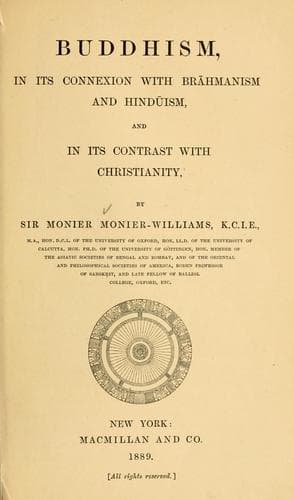
Buddhism, in Its Connexion with Brahmanism and Hinduism, and in Its Contrast with ChristianityMonier-Williams, Monier, Sir
Religion
Buddhism, in Its Connexion with Brahmanism and Hinduism, and in Its Contrast with Christianity
Monier-Williams, Monier, Sir
Buddhism; Buddhism -- Relations -- Christianity; Christianity and other religions -- Buddhism; India -- Religion
On another occasion, when Mr. Sarat Chandra Dās was seriously ill in
Tibet, an effective method of curing his disease was proposed to him,
and, with his consent, actually carried out. This mainly consisted in
the ransoming of fish-life. A certain Lāma started off for a fisherman’s
village, and in a short time returned in a high state of satisfaction.
He had saved the lives of five hundred fishes for the benefit of the
sick man. The merit of this deed was credited to the patient on his
repeating the following prayer:—
‘By virtue of my having ransomed the lives of these animals, let health,
longevity, prosperity, and happiness perpetually accrue to me.’
In the same way in Burma, in times of great heat and drought, when the
ponds and tanks appear to be on the point of drying up, it is held to be
a work of enormous merit to rescue fish, put them in jars, and transport
them alive to the rivers. (See Scott’s ‘Burman,’ ii. 43.)
Similarly a bird-catcher will sell live birds to pious persons, that
they may gain merit by releasing them.
We pass on, in the next place, to the usages and ceremonies common at
death.
If a man’s soul is to be separated from his body properly and
peacefully, so as not to hurt the survivors, and in a manner likely to
cause a happy re-birth for himself, alms must be bestowed on the
monk-priests, and their presence must be invited for the repetition of
prayers. In Ceylon and Burma monks go to the houses of mourners and
repeat portions of the Pirit (see p. 317).
In Tibet the priest not only recites prayers but compresses the skull
till it appears to crack, or else the hair is torn off and a little
incision is made, to enable the dying man’s soul to escape. The priest
then settles what method of burial is to be followed, and the place, day
and hour, all of which depend on astrological combinations, known only
to him.
The method of disposing of a dead body differs in all Buddhist countries
according to station, condition, rank, and wealth.
In Ceylon the bodies of monks are all burnt, and the cremation
ceremonies are carried out under decorated arches or canopies, which are
never removed, but left to crumble away.
Public-domain text, read in full here on John Shaqi.
Reviews
Reviews
No reviews yet
Be the first to share your thoughts on this work.
Elsewhere in the archive
Join the Discussion
Join the discussion
Sign in to leave a comment or review.
Sign InorCreate an account