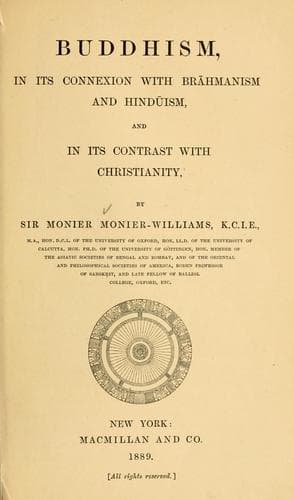
Buddhism, in Its Connexion with Brahmanism and Hinduism, and in Its Contrast with ChristianityMonier-Williams, Monier, Sir
Religion
Buddhism, in Its Connexion with Brahmanism and Hinduism, and in Its Contrast with Christianity
Monier-Williams, Monier, Sir
Buddhism; Buddhism -- Relations -- Christianity; Christianity and other religions -- Buddhism; India -- Religion
The Rājā’s sister had died a few days after his return to Choombi. The
body had been buried at Choombi, but her clothes had been sent to
Toomlong, and her soul was supposed to accompany them. There a
lay-figure meant to represent her, dressed in her costume as a nun,
and wearing a gilt mitre and a long white veil, was placed on a kind
of throne to the right of the great altar in the principal chapel.
Before the figure was a table, on which were different kinds of food.
On another table were various things which had belonged to her, while
on a third, 108 little brass lamps were arranged in rows. Some days
afterwards the lay-figure of the nun was taken to Pemyangchi. There,
for three days the figure was seated before the altar, and the monks
chanted the litanies for her soul, which had accompanied her clothes
from Choombi. On the third day towards evening the tea-cup of the nun
was freshly filled with tea, and all the monks solemnly drank tea with
her. The monks chanted the litanies, and the Head Lāma went through
some elaborate ceremonies. At about nine o’clock the chanting ceased,
and the Lāma made a long speech to the soul of the nun, in which he
told her that all that could be done to make her journey to another
world easy, had been done, and that now she would have to go alone and
unassisted to appear before the King and Judge of the dead.
‘You will have to leave your robes, your mitre, and your veil,’ said
he, ‘and clad in the black garment of your sins, or in the shining
garment of your good deeds, you will be shown the mirror of the just
King. Your gold and silver, your rank, your good name will not help
you, when your good deeds are weighed against your evil deeds, in the
scales of the King. If you have done ill, you will be punished; but if
your sins are found to be lighter than your good works, your reward
will be great indeed.’
When the Lāma had finished his address, some of the monks took down
the lay-figure and undressed it, while others formed a procession and
conducted the soul of the nun into the darkness outside the monastery,
with a discordant noise of conch-shells, thigh-bone trumpets, Tibetan
flutes, gongs, cymbals, tambourines, and drums.
In Japan small portions of the calcined remains (often not larger than
peas) are preserved in globular glass shrines, and then duly honoured
and worshipped.
The method of disposing of the dead bodies of the laity and of the
common people is generally much more simple. In most Buddhist countries
laymen are buried, and the priests lead the processions to the grave. In
Ceylon, the laity are certainly, as a rule, buried and not burnt.
In Burma rich laymen are also generally buried, and, according to Mr.
Scott, the funeral is a grand affair.
Public-domain text, read in full here on John Shaqi.
Reviews
Reviews
No reviews yet
Be the first to share your thoughts on this work.
Elsewhere in the archive
Join the Discussion
Join the discussion
Sign in to leave a comment or review.
Sign InorCreate an account