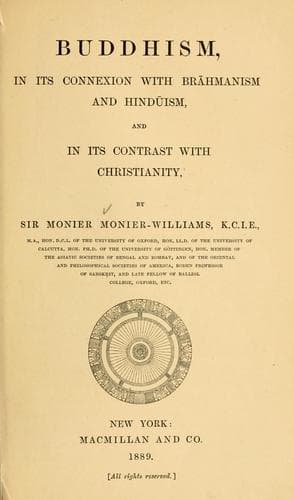
Buddhism, in Its Connexion with Brahmanism and Hinduism, and in Its Contrast with ChristianityMonier-Williams, Monier, Sir
Religion
Buddhism, in Its Connexion with Brahmanism and Hinduism, and in Its Contrast with Christianity
Monier-Williams, Monier, Sir
Buddhism; Buddhism -- Relations -- Christianity; Christianity and other religions -- Buddhism; India -- Religion
To begin with the oldest monastery, that of _Lā brang_, said to mean
‘abode of Lāmas[233],’ which was built by King Srong Tsan Gampo (see p.
271 of this volume), and founded in the seventh century. This ancient
institution is in the very centre of Lhāssa, and is regarded as the
centre of the whole country. All the main roads of Tibet converge
towards it. Doubtless the area of the monastery has been enlarged by
occasional additions in the course of one thousand years, but not since
it was partly rebuilt and restored in the seventeenth century. Its
magnificent temple (Cho Khang) is the St. Peter’s of Lāmism (see p.
459).
The immense number of monks inhabiting this monastery is proved by the
fact that a huge cauldron is shown which holds more than 1200 gallons of
tea for the Lāmas who perform the daily services.
The other three monasteries near Potala and Lā brang, according to
Koeppen, are devoted to the study of magic and the art of exorcising. We
may take them in the following order:—
First, at a short distance north of Lā brang, stands the monastery
_Ramoćhe_, ‘the great enclosure,’ which was the other ancient monastery
built by Srong Tsan Gampo, or by one of his wives (see p. 271). It is
now a great school of exorcism, and has a celebrated temple (see pp.
462, 463), containing the celebrated image of the Buddha, and also one
of Nanda, Gautama’s step-brother and disciple. Those who study here may
gain the decree of ‘Doctor of Magic.’
Next comes the monastery of _Moru_ (or Muru or Meru), close to the city.
It is noted for its order and cleanliness, and for its printing-press.
Like the last, it contains a school for instruction in magic.
Then, at a short distance east of Lā brang (according to Koeppen), is
the monastery of _Gar Ma Khian_—the mother monastery of soothsayers,
fortune-tellers, and exorcisers (Ćhos-kyong, see p. 266).
Let us next turn to the three ancient ‘mother-monasteries’ of the Yellow
sect—Galdan, Sera, and Dapung.
_Galdan_ (_or Gahdan_), the ‘heaven of contented beings’ (Sanskṛit
Tushita, see pp. 207, 213)—the oldest monastery of the Yellow sect—is
situated on the hill of the same name, about thirty miles[234] east of
Lhāssa. As already stated (pp. 278, 294), it was founded by Tsong Khapa
A.D. 1409. It is three-quarters of a mile in circumference, and has 3300
monks.
_Sera_, ‘the golden,’ founded by Tsong Khapa (p. 278), or by one of his
disciples immediately after his death, lies about three miles north of
Lhāssa, on a declivity of a hill, over which passes the road leading to
Mongolia. It has 5500 monks, and numerous temples, towers, and houses
curving round like an amphitheatre. On the hills above the town are rows
of cells of contemplative monks and recluses.
Sera has three great temples several stories high, the halls of which
are richly gilded. In one temple the staff of Gautama Buddha is
preserved.
Public-domain text, read in full here on John Shaqi.
Reviews
Reviews
No reviews yet
Be the first to share your thoughts on this work.
Elsewhere in the archive
Join the Discussion
Join the discussion
Sign in to leave a comment or review.
Sign InorCreate an account