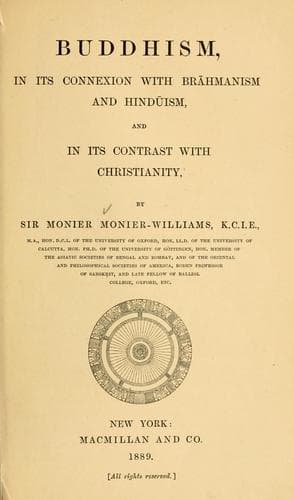
Buddhism, in Its Connexion with Brahmanism and Hinduism, and in Its Contrast with ChristianityMonier-Williams, Monier, Sir
Religion
Buddhism, in Its Connexion with Brahmanism and Hinduism, and in Its Contrast with Christianity
Monier-Williams, Monier, Sir
Buddhism; Buddhism -- Relations -- Christianity; Christianity and other religions -- Buddhism; India -- Religion
The fourth stage is that of the completely freed man who attains
Arhatship (Arahattaṃ) in this life, and will at death experience no
re-birth. There is, of course, a difference between one who has only
just entered each stage of the journey and one who has reached the
terminus. And this Arhatship is open to all (even to women), though only
likely to be attained by true monks or true nuns. The name Arhat (Pāli
Arahā, in Ceylon Rahat), ‘most deserving’ (root _arh_), is significant
of the highest merit; for the Arhat is perfect, freed from all pain
(nishkleṡa), from all the ten fetters, from all attachment to existence
(upādāna) whether on earth or in heaven, and from all re-creative
Act-force. He has already entered Nirvāṇa, and while still living he is
dead to the world. He is the Jīvan-mukta, ‘emancipated living man,’ of
the Yoga. By the force of the fourth Dhyāna, he has gained the Abhijñās
(Abhiññā), or ‘transcendent faculties of knowledge,’ the inner eye,
inner ear, knowledge of all thoughts, and recollection of previous
existences, and the extraordinary powers over matter called Iddhi (=
Ṛiddhi). In short he is Asekha, ‘one who has nothing to learn.’
Although, theoretically, a layman and even beings existing in other
spheres, might enter the stream leading to Arhatship (see p. 90) without
becoming monks, yet it is evident that as a rule it was only likely to
be entered by persons who renounced the world and led a celibate
monastic life.
But of Arhats there are three grades:—
First, the simple Arhat (described above), who has attained perfection
through his own efforts and the doctrine and example of a supreme
Buddha, but is not himself such a Buddha, and cannot teach others how to
attain Arhatship, though he associates with others.
Secondly, and second in rank, but far above the simple Arhat, the
Pratyeka-Buddha or Solitary Saint, who has attained perfection for
himself and by himself alone, and not as a member of any monastic Order,
nor through the teaching of any supreme Buddha (except in some former
birth). This solitary hermit-like Arhat—a kind of concentration of
isolated or selfish sanctity—is symbolized by a rhinoceros. He does not
appear on earth at the same time with a supreme Buddha, and has not the
same epithets (p. 23) applied to him.
Public-domain text, read in full here on John Shaqi.
Reviews
Reviews
No reviews yet
Be the first to share your thoughts on this work.
Elsewhere in the archive
Join the Discussion
Join the discussion
Sign in to leave a comment or review.
Sign InorCreate an account