“Even here, in this region of wonders, I find
That light-footed Fancy leaves Truth far behind,
Or at least, like Hippomenes, turns her astray
By the golden illusions he flings in her way.”
[Illustration: CIRCE.
From painting by Burne-Jones.]
[Illustration: THE THREE FATES.
From painting by Michael Angelo. Pitti Gallery, Florence.]
————
CHAPTER XIX
HERCULES—HEBE AND GANYMEDE
HERCULES
HERCULES was the son of Jupiter and Alcmena. As Juno was always hostile
to the offspring of her husband by mortal mothers, she declared war
against Hercules from his birth. She sent two serpents to destroy him as
he lay in his cradle, but the precocious infant strangled them with his
own hands. He was, however, by the arts of Juno rendered subject to
Eurystheus and compelled to perform all his commands. Eurystheus
enjoined upon him a succession of desperate adventures, which are called
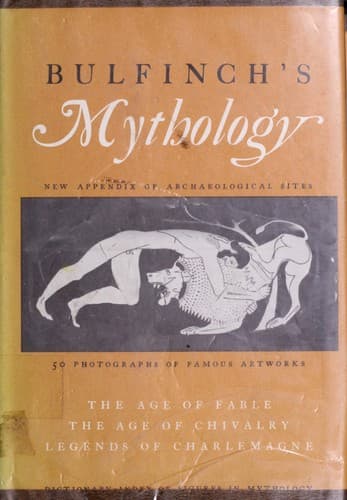
the “Twelve Labors of Hercules.” The first was the fight with the Nemean
lion. The valley of Nemea was infested by a terrible lion. Eurystheus
ordered Hercules to bring him the skin of this monster. After using in
vain his club and arrows against the lion, Hercules strangled the animal
with his hands. He returned carrying the dead lion on his shoulders; but
Eurystheus was so frightened at the sight of it and at this proof of the
prodigious strength of the hero, that he ordered him to deliver the
account of his exploits in future outside the town.
His next labor was the slaughter of the Hydra. This monster ravaged the
country of Argos, and dwelt in a swamp near the well of Amymone. This
well had been discovered by Amymone when the country was suffering from
drought, and the story was that Neptune, who loved her, had permitted
her to touch the rock with his trident, and a spring of three outlets
burst forth. Here the Hydra took up his position, and Hercules was sent
to destroy him. The Hydra had nine heads, of which the middle one was
immortal. Hercules struck off its heads with his club, but in the place
of the head knocked off, two new ones grew forth each time. At length
with the assistance of his faithful servant Iolaus, he burned away the
heads of the Hydra, and buried the ninth or immortal one under a huge
rock.
Another labor was the cleaning of the Augean stables. Augeas, king of
Elis, had a herd of three thousand oxen, whose stalls had not been
cleansed for thirty years. Hercules brought the rivers Alpheus and
Peneus through them, and cleansed them thoroughly in one day.
Public-domain text, read in full here on John Shaqi.
Reviews
Reviews
No reviews yet
Be the first to share your thoughts on this work.
Elsewhere in the archive
Join the Discussion
Join the discussion
Sign in to leave a comment or review.
Sign InorCreate an account