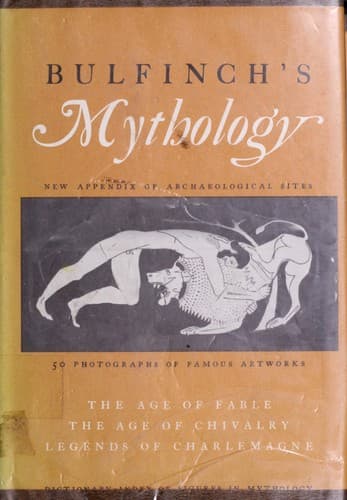
The ancients were fond of finding a hidden meaning in their mythological
tales. They explain this fight of Achelous with Hercules by saying
Achelous was a river that in seasons of rain overflowed its banks. When
the fable says that Achelous loved Dejanira, and sought a union with
her, the meaning is that the river in its windings flowed through part
of Dejanira’s kingdom. It was said to take the form of a snake because
of its winding, and of a bull because it made a brawling or roaring in
its course. When the river swelled, it made itself another channel. Thus
its head was horned. Hercules prevented the return of these periodical
overflows by embankments and canals; and therefore he was said to have
vanquished the river-god and cut off his horn. Finally, the lands
formerly subject to overflow, but now redeemed, became very fertile, and
this is meant by the horn of plenty.
There is another account of the origin of the Cornucopia. Jupiter at his
birth was committed by his mother Rhea to the care of the daughters of
Melisseus, a Cretan king. They fed the infant deity with the milk of the
goat Amalthea. Jupiter broke off one of the horns of the goat and gave
it to his nurses, and endowed it with the wonderful power of becoming
filled with whatever the possessor might wish.
The name of Amalthea is also given by some writers to the mother of
Bacchus. It is thus used by Milton, “Paradise Lost,” Book IV.:
“. . . That Nyseian isle,
Girt with the river Triton, where old Cham,
Whom Gentiles Ammon call, and Libyan Jove,
Hid Amalthea and her florid son,
Young Bacchus, from his stepdame Rhea’s eye.”
ADMETUS AND ALCESTIS
Æsculapius, the son of Apollo, was endowed by his father with such skill
in the healing art that he even restored the dead to life. At this Pluto
took alarm, and prevailed on Jupiter to launch a thunderbolt at
Æsculapius. Apollo was indignant at the destruction of his son, and
wreaked his vengeance on the innocent workmen who had made the
thunderbolt. These were the Cyclopes, who have their workshop under
Mount Ætna, from which the smoke and flames of their furnaces are
constantly issuing. Apollo shot his arrows at the Cyclopes, which so
incensed Jupiter that he condemned him as a punishment to become the
servant of a mortal for the space of one year. Accordingly Apollo went
into the service of Admetus, king of Thessaly, and pastured his flocks
for him on the verdant banks of the river Amphrysos.
Public-domain text, read in full here on John Shaqi.
Reviews
Reviews
No reviews yet
Be the first to share your thoughts on this work.
Elsewhere in the archive
Join the Discussion
Join the discussion
Sign in to leave a comment or review.
Sign InorCreate an account