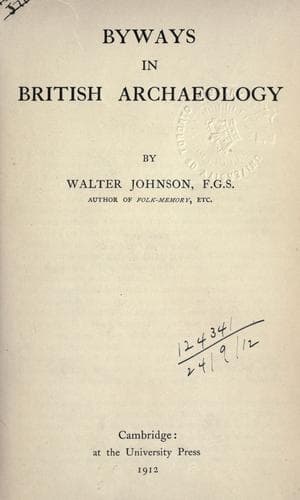
Christian antiquities -- Great Britain; Folklore -- Great Britain; Great Britain -- Antiquities
Attention has been drawn by Mr W. F. Hobson to an early allusion to
orientation, involving, as he considers, the principle of deflection
also. The passage occurs in the writings of St Paulinus of Nola, c. A.D.
420. Speaking of a church which he had built, St Paulinus remarks,
“_Prospectus basilicae vero non, ut usitatior mos est, Orientem spectat,
sed ad Domini mei B. Felicis basilicam pertinent Memoriam ejus
aspiciens_[598].” The statement is that the outlook of the church was
not directed towards the East, following the more common practice, but
towards a certain basilica, containing a particular tomb, that of the
martyred presbyter, St Felix. That we have here an early instance of
orientation is manifest, but whether “_aspiciens_” may be interpreted so
as to prove deflection is doubtful. It is, however, possible that while
the church had its general alinement to the sacred basilica, there was a
bend or slant which caused the “chancel”--speaking conventionally--to
face the monument. Mr Hobson urges that, from orientation towards a tomb
and orientation for a Saint’s Day there is but a slight transition[599].
We will now attempt to sum up the evidence. Skew chancels were, in some
cases at least, due to carelessness or unskilfulness. A few deflections
seem to have been caused by the architect’s dislike to build on old
foundations--a prejudice felt by Wren in re-building St Paul’s. The
Saint’s Day theory may hold for some examples, since a few positive
instances of observance, if these can be produced, cannot be nullified
even by many negative exceptions. As to the symbolism of the leaning
head, whimsical though it may at first sight appear, one cannot dismiss
it as mere folly. Mediaeval symbolism was no dead art, and it is visible
in many guises, though to a less extent than its advocates would insist.
Unless, therefore, we are to believe that symbolical explanation is
altogether an after-thought--the creation of cultured ecclesiastics--we
have to find a reason for its existence in Mediaeval days. And, if the
idea be so old as the foundation of our finest churches, we may
conjecture that it received an embodiment in architecture. Lastly, the
theory of artistic design, though least advocated, seems most in
consonance with all the facts. The deflection does cause an agreeable
optical illusion; and it is probable that this was intended. While we
search in vain for some early document to throw a glimmering of light on
the problem, we are bound to consider all tentative solutions
unsatisfactory. He would be a bold man who should unhesitatingly affirm
that one explanation will meet every case, and hardier still would be
the prosaic architect who should dismiss every instance of deflection as
the result of pure chance or blundering ignorance.
CHAPTER VI
THE ORIENTATION OF GRAVES
Public-domain text, read in full here on John Shaqi.
Reviews
Reviews
No reviews yet
Be the first to share your thoughts on this work.
Elsewhere in the archive
Join the Discussion
Join the discussion
Sign in to leave a comment or review.
Sign InorCreate an account