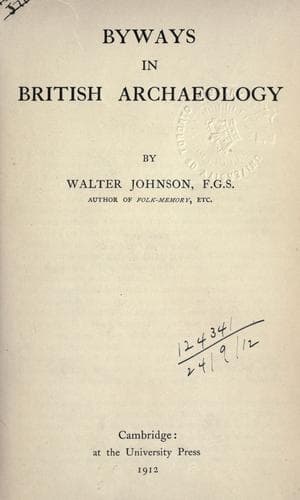
Christian antiquities -- Great Britain; Folklore -- Great Britain; Great Britain -- Antiquities
Having uttered these objections, and having implied the necessity of
slow-moving circumspection, one cannot think that the boundary of
knowledge has yet been reached. Frequently, excavations reveal little
more evidence than was already suspected after critical external
examination. If then the archaeologist and the astronomer can find
agreement in common premisses, the theodolite may indeed help the spade
and atone for its limitations. While feeling persuaded that our
megalithic monuments were never alined with such nicety that the
orientation can be expressed in seconds, one can still understand that
they may have been set out with greater accuracy than is commonly
supposed. When we recollect, too, that many of our megaliths had at
first probably a sepulchral purpose, we shall see no sufficient reason
why they should not have been planned, at any rate, as skilfully as
funeral earthworks.
The Rev. J. Griffith, indeed, carries the orientation theory further,
and applies it to primitive earthworks of a general character--those
which are popularly known as camps and forts. Speaking of Burrington
Camp, Somerset, he claims that its Southern bank is oriented to the
equinox, and that another bank corresponds both to the sunset line at
the summer solstice, and to sunrise at the winter solstice. He adds that
the star alinement of this earthwork has been “worked out” by Sir Norman
Lockyer to Arcturus. Castle Dyke, near Aysgarth, Yorkshire, gives
indications of an alinement either to Alpha Centauri or to Capella[635].
These much-canvassed theories have led us away from our highroad, yet
the digression was really slight, seeing that many of our megaliths mark
the position of early burial-places. It is not asserted that all our
ancient stone monuments are of this character, but some, at least, of
those which are claimed as “temples,” were primarily graves; hence they
come under our survey. Here, too, it seems fitting to notice another
matter, dependent to some extent on the orientation of graves, and
illustrative of the persistency of unconscious folk-memory.
Public-domain text, read in full here on John Shaqi.
Reviews
Reviews
No reviews yet
Be the first to share your thoughts on this work.
Elsewhere in the archive
Join the Discussion
Join the discussion
Sign in to leave a comment or review.
Sign InorCreate an account