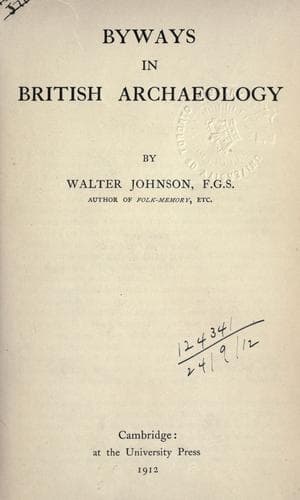
Christian antiquities -- Great Britain; Folklore -- Great Britain; Great Britain -- Antiquities
A remarkable instance of anticipation will illustrate, to some extent,
what has just been said. The antiquary is well aware that, during the
Stuart period, in order to encourage the woollen industry, statutes were
passed (A.D. 1666, 1678, 1680), which made it compulsory to bury the
dead in woollen shrouds. An interesting chapter of burial-lore might be
written on this curious subject, for the Acts, though they had long been
in abeyance, were not repealed until late in the reign of George III.
(A.D. 1814)[683]. The practice is recalled in our own day when, by
request of the dying person, the body is enfolded in some special garb,
usually of wool, before being committed to the earth. The strange
circumstance, however, is that such a custom should have been
foreshadowed in the far-away past. In Danish burials belonging to the
earliest Bronze Age, the bodies are sometimes found to have been placed
in hollowed tree trunks, and the remains show that a woollen shroud had
been used. Skeletons wrapped in a woollen textile have likewise been
discovered at Rylston, in the Western Riding of Yorkshire[684]. I have
provisionally regarded these instances as revealing anticipations rather
than origins, but it is possible that many intermediate examples could
be supplied. One of these gradations is perhaps traceable in the custom
of burying a person in his ordinary dress. If these links were
complete, there would obviously be entire continuity, but if we
encountered a gap, it is probable that the eighteenth century practice
would have to be considered as a “throw-back.”
It is now time to review the custom, still common among uncivilized
peoples, and once extremely popular in Britain, of placing objects with
the corpse in the grave. A mass of evidence has been collated and
examined, and though only a portion can be given here, we must, while
shunning tediousness, present as much detail as is actually profitable.
A rough preliminary classification of these funerary objects would
include, (1) weapons and useful implements; (2) amulets, talismans, and
symbolical objects; (3) trinkets, ornaments, and decorative articles;
(4) a miscellaneous group, partly useful, partly symbolical or
commemorative. It is necessary to premise that this classification is
conventional, and lacks well-defined boundaries, hence, while dealing
with one series of relics, other groups will be forced upon our
attention, producing, later, unavoidable repetition.
Public-domain text, read in full here on John Shaqi.
Reviews
Reviews
No reviews yet
Be the first to share your thoughts on this work.
Elsewhere in the archive
Join the Discussion
Join the discussion
Sign in to leave a comment or review.
Sign InorCreate an account