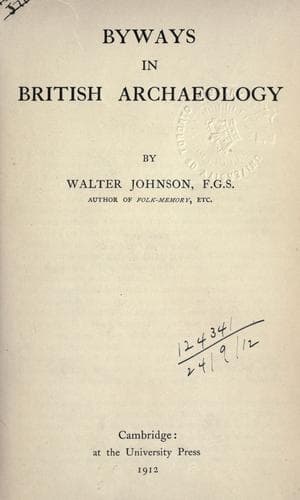
Christian antiquities -- Great Britain; Folklore -- Great Britain; Great Britain -- Antiquities
We have yet to review, very briefly, three or four interesting subjects
which fall within the scope of this already lengthy chapter. The Burial
Service of the Anglican Church provides for earth to be cast on the
coffin “by some standing by,” while the priest pronounces the solemn
words, “earth to earth, ashes to ashes, dust to dust.” This combination
of phrases has been traced to a similar passage in the Sarum Manual, a
passage founded in turn, it is supposed, on several Biblical
expressions[799]. A little doubt, however, hangs over the ultimate
origin of the words of the Commendation, though the precise form of the
phrases may be due to Scriptural influence. The idea underlying the
words, and its mode of operation, are alike ancient. For my part, I
think that the expression plainly points to a time when cremation and
inhumation were both familiar to the community; that is to say, some
equivalent words were used when the early Christians of Britain had
begun to combat, not altogether with success, the system of burning the
body. If the words “earth to earth” and “dust to dust” stood alone, it
might fairly be argued that the compilers of the earliest Services
believed literally in the creation of man from the dust. But the phrase
“ashes to ashes” forbids that interpretation. It has, so far as may be
known, never been taught that man originally came from ashes, though,
figuratively, in moments of contrition, he has declared himself to be
“but dust and ashes.” The collocation of the phrases seems to betray a
compromise between modes of burial. Parenthetically, we note that the
Roman practice, as described by Horace, was to cast earth three times
upon the body[800]. Until this was done, the spirit could not enter
Elysium. It is probable that a like custom goes back to the Barrow
period. Canon Greenwell supposes that, at a barrow funeral, each of the
tribesmen carried his portion of earth, probably in a basket[801]. This
conjecture receives support from the conduct of certain South African
tribes, the members of which share the task of scooping together the
material for the burial-mound, using however, for that purpose, the
hands alone. The same procedure is followed by Lascars when burying a
comrade in a strange land[802].
Public-domain text, read in full here on John Shaqi.
Reviews
Reviews
No reviews yet
Be the first to share your thoughts on this work.
Elsewhere in the archive
Join the Discussion
Join the discussion
Sign in to leave a comment or review.
Sign InorCreate an account