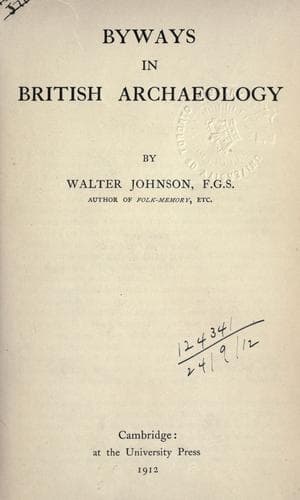
Christian antiquities -- Great Britain; Folklore -- Great Britain; Great Britain -- Antiquities
The headstones, it will be remembered, carry us back only a few
centuries. But, so far as these memorials reach, they tell
overwhelmingly in favour of the superstition. Twenty years ago, this
evidence was much more patent to the eye. A very general exception,
however, must be made of the town churchyards, in which the old
tombstones are often found evenly distributed over the available space.
Several reasons may be adduced for this non-observance of the usual
practice. The town church, as a rule, stands centrally in its graveyard;
it is commonly approached by several alleys and paths, leading from a
thoroughfare or market-place; it is frequently cruciform in plan, with
North and South doors, and this design, wherever met with, seems to have
had some effect in counteracting the fears of the ignorant. Above all
these reasons, must be set the fact that populous districts would
soonest lose touch with the superstition, so that, even before the era
of headstones, the belief retained but a comparatively feeble foothold
among the inhabitants of towns. The argument from monuments fails in
cases such as these. We must seek the tradition in the rural districts,
and turn back to a time when it was more firmly held. We shall then see
that the present exceptions, numerous as they are, cannot invalidate the
general practice. They represent what Professor L. C. Miall, writing on
a vexed question in botany, calls “negative exceptions.” I venture to
repeat his witty illustration: “A wooden leg is used to enable a man to
walk when he has lost his natural leg. If you saw a one-legged man
walking with a pair of crutches, and no wooden leg at all, would that
shake your belief in the motive for using wooden legs[902]?” The
“negative exceptions” which we have been studying may, indeed, testify
to a weakening of tradition, or occasionally, to its apparent local
non-existence, but they do not abolish it, or change its purport one
whit. How it chances that, of two adjacent parishes, the present-day
evidence shows the belief at work in the first, but seemingly unknown,
or in abeyance, in the second, is a matter upon which we can only
speculate. The puzzle reminds one of the difficulty which meets the
palaeontologist when he strives to explain why one line of animal
descent stops, and remains fixed, while another continues to develop;
why creatures which seem to be completely adapted to their surroundings
become extinct; why one species or genus is taken, and another left.
Public-domain text, read in full here on John Shaqi.
Reviews
Reviews
No reviews yet
Be the first to share your thoughts on this work.
Elsewhere in the archive
Join the Discussion
Join the discussion
Sign in to leave a comment or review.
Sign InorCreate an account