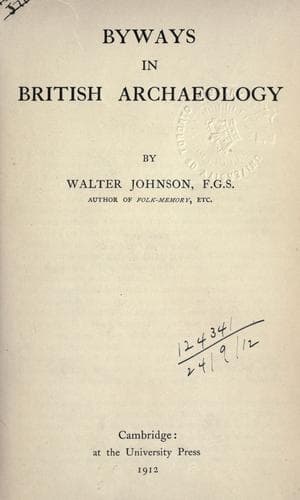
Christian antiquities -- Great Britain; Folklore -- Great Britain; Great Britain -- Antiquities
church was built. It has, indeed, been asserted that an urn was dug up
in the churchyard itself, but of this I can obtain no confirmation. The
late incumbent, the Rev. R. H. Anketell, for the loan of whose
manuscript I am indebted to Miss Stebbing, strongly argued that the
church was erected on a barrow, but Mr Wright’s observations do not
verify this hypothesis. A second discovery, however, was made under the
church and in the churchyard during the recent restoration of the
building. This consisted of a number of boulders, some vertical, others
recumbent, pitted with what are popularly known as “pebble-holes.” The
stones were all devoid of tooling. The proximate origin of the stones
was the Boulder Clay of the district. Two of the blocks were found
under the angles of the tower, two others came from beneath the chancel,
while three were situated in, or near, the churchyard. It is also known
that other specimens had been carried away in past times, for the
purpose of repairing walls and farm buildings. Mr Anketell considered
that the church had been built over a stone-circle, but one must
hesitate a little before yielding assent. The group of stones may
represent a portion of the builder’s stock, yet we must interpret the
discovery by the light of similar occurrences. It should be added, as
establishing another bond of continuity, that Roman pottery is turned up
from time to time in the neighbourhood.
In pondering the foregoing examples, we ought frequently to call to our
aid comparative customs in more remote parts of the British Isles.
Taking Ireland, for instance, it will be seen that that country is
fertile in the kind of evidence so deplorably scanty in those portions
of Britain which have been most disturbed and overrun by the spoiler.
One instance alone, as related by Mr W. G. Wood-Martin, will exemplify
the difference in the quality of the evidence. In the graveyard of the
very early church at St John’s Point, co. Down, there were discovered
numerous pagan graves arranged in a circle. Within this series, and
arranged concentrically, was another ring of smaller graves, while the
common centre was marked by a stone pillar[236]. After this concluding
example, we may sum up this side of the evidence. Occasionally, it must
be admitted, the juxtaposition of pagan and Christian burials may be the
result of coincidence. Pre-Christian burials are so abundant and so
widely scattered that, by chance, the church builders may have stumbled
on a forgotten cemetery. But this explanation will not cover the whole
of the cases. While it may be urged, with respect to the Alphamstone
cemetery, that there was probably a break in continuity, due to the
slackening of folk-memory, the objection is manifestly irrelevant to the
Taplow barrow, which must have been a conspicuous object when the
foundations of the church were being laid. Even with examples of the
Alphamstone type, there is the witness of tradition and superstition to
be heard.
Public-domain text, read in full here on John Shaqi.
Reviews
Reviews
No reviews yet
Be the first to share your thoughts on this work.
Elsewhere in the archive
Join the Discussion
Join the discussion
Sign in to leave a comment or review.
Sign InorCreate an account