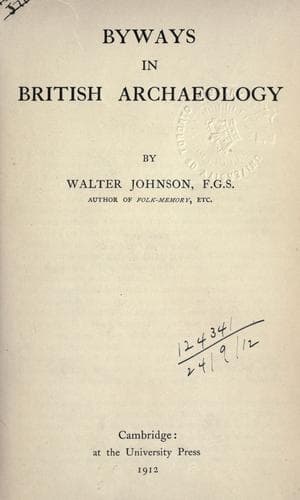
Christian antiquities -- Great Britain; Folklore -- Great Britain; Great Britain -- Antiquities
The salutary respect which was paid to the dead by primitive
folk, and the superstitious beliefs, cherished, half in fear, half in
hope, were centred around burial-places. These are facts to be graven on
the tablets of the memory of every archaeologist. Realizing how potent,
even to-day, are the traditions of ghosts, and fairies, and hidden
treasure, wherever the dead are known to lie, and remembering that
folk-memory has frequently proved to be sound in the identification of
graves previously overlooked by the antiquary, we are bound to conclude
that nothing short of the extermination of the whole of the inhabitants
of a country-side could completely wipe away such recollections. Even
to-day, after several centuries of the printed book, and several decades
of the day school, the most definite legends, and those with the
greatest living force, are those which the peasant connects with graves
and ghosts. How much stronger was this kind of tradition when delivered
orally from father to son, and when all folk alike were under the spell
of superstition!
If it be objected that the majority of Gothic churches, perhaps even the
majority of existing Saxon churches, do not stand near pagan
burial-grounds, that the general rule was to establish new cemeteries at
a distance from the old, one would naturally answer that it is just
these exceptions which prove that the chain of continuity was never
absolutely broken. The examples where old sites were seized upon might,
at first, be relatively numerous, but they would tend to become fewer
and fewer, as adherence to ancient heathen custom weakened. A time would
arrive when, save to combat a prejudice, the pagan spots would be
completely shunned, and all churches would be built on soil newly
hallowed. The evidence must be judged as a whole, and especial weight
will have to be allowed for the records of holy wells, which we must
review before closing the chapter. A combination of features will often
impress the most sceptical. When we find, hidden away in a wilderness of
moors and hills at Bewcastle, in the Northern corner of Cumberland, the
remains of a Mediaeval castle close to a restored twelfth century
church, while the shaft of a seventh century cross stands hard by, and
when we notice that a Roman camp of hexagonal outline--a rare
feature--encloses all these objects[237], we are justified in tracing a
causal connection. What, but deliberate purpose, conspired to make
warrior, churchman, and feudal lord, one after the other, settle in this
remote fastness? Confronted with testimony of this kind, the burden of
proof must rest upon those who would see, here and there, a distinct
hiatus in the history of social development. A parallel may be drawn
from the science of organic evolution. Recent researches have taught us
that we must be prepared to encounter “mutations” in the lines of
descent. It is also undeniable that ethnology may present us with
Public-domain text, read in full here on John Shaqi.
Reviews
Reviews
No reviews yet
Be the first to share your thoughts on this work.
Elsewhere in the archive
Join the Discussion
Join the discussion
Sign in to leave a comment or review.
Sign InorCreate an account