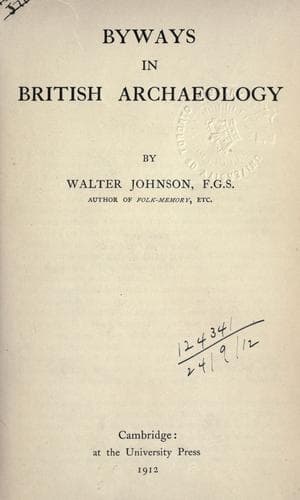
Christian antiquities -- Great Britain; Folklore -- Great Britain; Great Britain -- Antiquities
Among the most striking examples of elevated graveyards which have come
under my notice are those at Telscombe and Rottingdean in Sussex;
Brighstone or Brixton, in the Isle of Wight; and Milton Lilbourne, in
Wiltshire. Various writers have noticed a like feature in Breton and
Basque churchyards. After perusing these records afresh, two passages
from the writings of observant travellers come to mind. The first is
from Peter Kalm, the Swede, who visited England in 1748. He noticed
that the floor of the English church often goes deeper down than the
surface of the churchyard soil. From this, he inferred either that the
church had sunk, or that the earth of the churchyard had been raised,
owing to burials; unless, indeed, soil had been brought to the spot.
William Cobbett’s _Rural Rides_ affords a strong corroboration of the
facts. Cobbett’s keen eye missed little, and his quick intuition
sometimes--by no means always--suggested the correct explanation of
features which more careless tourists would have overlooked altogether.
The passage refers to the village of Rogate, near Petersfield in
Hampshire, and his remarks are so apt that a full quotation may be
pardoned. The letter is dated 12 November, 1825. “When we came to the
village of Rogate, I saw a little group of persons standing before a
blacksmith’s shop. The churchyard was on the other side of the road,
surrounded by a low wall. The earth of the churchyard was about four
feet and a half higher than the common level of the ground round about
it; and you may see, by the nearness of the church windows to the
ground, that this bed of earth has been made by the innumerable burials
that have taken place in it. The group, consisting of the blacksmith,
the wheelwright, perhaps, and three or four others, appeared to me to be
in a deliberative mood. So I said, looking significantly at the
churchyard, ‘It has taken a pretty many thousands of your forefathers to
raise that ground up so high.’ ‘Yes, sir,’ said one of them[241].”
Cobbett then proceeds with a little socratic questioning of the
villagers, in order to point a political moral, but with this we are not
concerned. As he trots off on his nag, however, he begins to estimate
how many hundreds of years a church has stood on the spot, and here our
musings may be in accord with his once more.
Public-domain text, read in full here on John Shaqi.
Reviews
Reviews
No reviews yet
Be the first to share your thoughts on this work.
Elsewhere in the archive
Join the Discussion
Join the discussion
Sign in to leave a comment or review.
Sign InorCreate an account