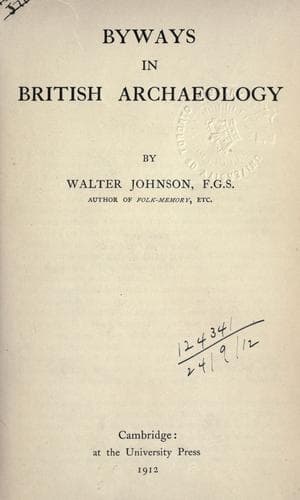
Christian antiquities -- Great Britain; Folklore -- Great Britain; Great Britain -- Antiquities
One of the examples best known to the writer is that of Churchdown, in
Gloucestershire. The church stands on a Liassic hill of pyramidal
outline, 500 feet above the sea-level. To climb the steep slope from the
village below is an arduous task. The devil-theory still thrives
vigorously in the neighbourhood, and the visitor will soon hear the
account of the nightly removal of the stones by the spirit of evil. It
chances that the local pronunciation of Churchdown is “Chōsen,” and this
has suggested to the otherwise serious countryfolk a weak pun. Not only,
they say, was the spot deliberately “chosen,” but the “chosen people” of
the Prayer-Book response refers specifically to the favoured inhabitants
of the village. The traveller cannot escape--
“Full of their theme, they spurned all idle art,
And the plain tale was trusted to the heart.”
Breedon church, in Leicestershire, is on a hill which similarly
overlooks the village clustered at the foot. For pedestrians, the ascent
has been made easier by cutting steps in the pathway, but carriages have
to take a circuitous route to reach the church[270]. Other churches
concerning which a contest was waged between Christian masons and the
powers of darkness are St Chad’s, Rochdale, and Capel Garmon, in
Denbighshire. In the second of these cases, the church was to have been
erected on a hill, contiguous to an ancient spring, but the stones were
repeatedly carried to a lower position[271]. This detail respecting the
spring is not without significance, as was shown in the last chapter.
Another illuminative Welsh example comes from Llanllechid, near Bangor.
Here the fairies, or spirits, bore away the stones from a field called
Caer Capel, and actually selected a situation--so the legend runs--more
convenient than the first[272]. Both Caer Capel and Llanllechid are
suggestive names, the latter gives a hint of a church built on the site
of megaliths. At Wendover, in Buckinghamshire, the builders were
thwarted by malevolent witches: at Hanchurch and Walsall, in
Staffordshire, the trouble was caused by mischievous fairies. Each
locality has its own bit of colour tinging the testimony, but to
rehearse all the variations would be tedious. The number of these
solitary hill-top churches was once probably much greater than at
present. In some instances the buildings have been demolished; in
others, modern dwellings have sprung up around the church and have
masked its isolated position. Indeed, this shifting of the population is
a factor which must never be left out of sight.
Public-domain text, read in full here on John Shaqi.
Reviews
Reviews
No reviews yet
Be the first to share your thoughts on this work.
Elsewhere in the archive
Join the Discussion
Join the discussion
Sign in to leave a comment or review.
Sign InorCreate an account