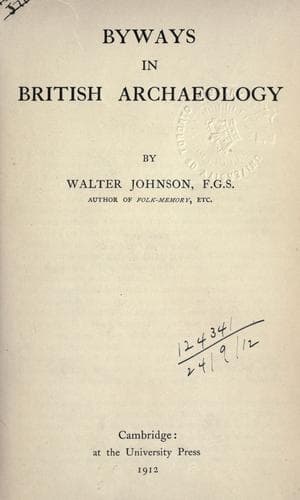
Christian antiquities -- Great Britain; Folklore -- Great Britain; Great Britain -- Antiquities
The erection of a church on soil hitherto relegated, by silent consent,
to primitive tribal folk, or, failing these, to the wild beasts, was a
novel and startling event. We need not assume that the primary purpose
of the builders was to Christianize those remote peoples, though that
may have been a subsidiary motive. It is more likely that the church was
intended for the churchmen who built it. But to enter an area previously
left intact would provoke keen opposition. Further, it is now a
commonplace that our stories of witches and wizards, fairies and demons,
are in part, at least, derived from folk of the Neolithic and Bronze
periods, or from their near descendants. To the conquered people was
imputed magical power, while to the victors, their weapons, and their
appliances, the beaten folk paid the respect due to fear. Briefly, then,
the superstitions which we are considering seem to speak of the
projection of one race over territory long occupied by the survivors of
much earlier races, and again, of the intrusion of social habits and
religious customs among folk whose beliefs and modes of life were widely
different from those of the invaders.
Still the question is unanswered, Why were hill-tops chosen as sites of
churches? Primarily, of course, the churches were built for worship, but
the answer to the question seems to be, that, in very many cases, the
building was intended for temporary refuge and defence in those
unsettled centuries which lasted down to the Wars of the Roses (cf. p.
57 _supra_, concerning earthworks). To establish this theory, we must
consider a moderate number of instances extracted from a lengthy list.
And a clearer understanding will be promoted if our minds are chiefly
fixed, for the present, upon church towers alone, because these are the
portions of the buildings which best illustrate the theory.
Public-domain text, read in full here on John Shaqi.
Reviews
Reviews
No reviews yet
Be the first to share your thoughts on this work.
Elsewhere in the archive
Join the Discussion
Join the discussion
Sign in to leave a comment or review.
Sign InorCreate an account