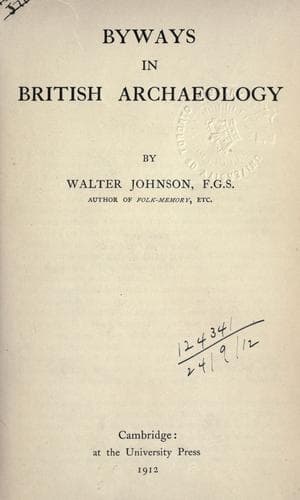
Christian antiquities -- Great Britain; Folklore -- Great Britain; Great Britain -- Antiquities
Leaving the tower, we come next to the nave of the church, and approach
an attractive study--one that has exercised the minds of many observers.
Why should the size of the nave be often so utterly disproportionate to
the congregation which it has to accommodate? Has the population changed
inversely to such an extent since the church was built? One might
rashly deem the riddle solved by a reference to acts enforcing
conformity in religion, or to the half-truth that “all persons went to
church in those days.” On rare occasions, perchance, the inhabitants did
all go to church, at least those who were neither infantile nor
bed-ridden. But these explanations are idle. Churches may be found,
which, even if we allow that every adult in the village was a regular
churchgoer, could never at any time have been quite filled at a purely
religious service.
Various answers have been given to the troublesome query. At Thaxted, in
Essex, in whose church, as the natives say, all the parishioners might
comfortably be put to bed, the excess of accommodation is thought to be
explainable on the assumption that the builders provided for a growing
population. The general facts, however, are strongly against this
notion. William Cobbett, who will be admitted as a careful observer,
though his conclusions were frequently hasty, exemplified both his
strength and his weakness in discussing this subject. Over and over
again, in his _Rural Rides_, and his _History of the Protestant
Reformation_, he calls attention to churches, which, in his day, would
hold three or four times the total number of the inhabitants in the
respective parishes. From these facts, he deduces that the land in
Mediaeval times supported a greater number of folk, and that the
villages were larger and much more densely populated. Other writers,
favoured with greater opportunities than were available to Cobbett,
have, nevertheless, been betrayed into the same error. But the
population theory is now so generally discredited, that it is
unnecessary to rebut it directly by an appeal to the estimated
populations of the country during each successive century. Besides, an
estimated census of the population during the Edwardian period, for
instance, can never be more than approximate, and may itself cause more
controversy than the theory which it is warranted to disprove.
Public-domain text, read in full here on John Shaqi.
Reviews
Reviews
No reviews yet
Be the first to share your thoughts on this work.
Elsewhere in the archive
Join the Discussion
Join the discussion
Sign in to leave a comment or review.
Sign InorCreate an account