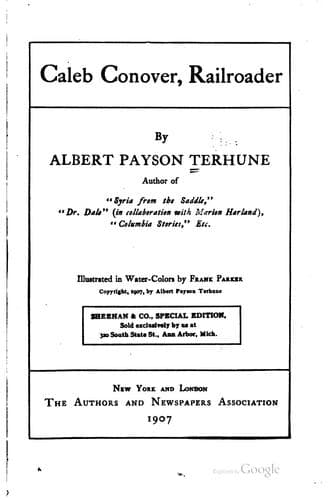
American fiction -- 20th century; Political fiction; Railroad stories; West (U.S.) -- Fiction
Now, at the clamor in the study, he pulled himself together. The iron
will still held. He strode to the connecting door and opened it. The
tumult had died down, and Staatz alone was now speaking. So intent were
the speaker and his hearers that none noted the Boss’s advent from so
unexpected a quarter. On the threshold stood Caleb, surveying the scene
with quiet contempt.
“And that’s how it is!” Staatz was declaiming. “We’re licked. _Licked!_
Pretty sort of news for Democrats _this_ is!” picking up a newly-broken
length of ticker tape around which the other men had been clustering.
“‘City of Grafton, complete: Conover 5,100, Standish 12,351.’ Is it a
wonder you all went nutty when you got it? In Grafton, too, stronghold
of Democracy. This means the State for Standish by an easy 4,000, maybe
more. And who’s to blame? Are you? Am I? Not us! We’ve had—the whole
party’s had—our hands tied behind us. And we were sent in to fight like
that. Could we use the good old moves? Not us! It must be kid-glove,
silk-sock, amachoor politics, meeting Standish on his own ground. No
wonder he licked us! A Prohibitionist could have licked men that were
hampered like we were. And who was it tied our hands? Who got the party
beat and the Machine smashed? Who did it? Caleb Conover!”
He paused panting and sweating with wrath. Then, encouraged by a murmur
of assent that ran around the ring of listeners, he bellowed:
“We ain’t in politics for our health, are we? It’s our bread and butter.
That bread and butter’s been snatched away from us. Who by? Caleb
Conover! Are you going to be led by the nose any longer by a man who
betrays you like that? For my part _I’m_ tired of wearing his collar.”
A growl of approbation greeted his query. His bellow changed to a lower
tone of persuasion.
“I ain’t saying,” he resumed, “but what Conover’s done work for the
Machine. In his day he was a great man, but his day’s past. He’s
breaking up. Don’t this campaign prove he is? Makes us throw our chances
out of the winder for Standish to pick up. And when we’re waiting news
from the deciding city he plays a phonograph, and then wanders off and
most likely forgets we’re here. There’s another thing: How did Richard
Croker and Charlie Murphy and Matt Quay and N. Bonaparte and all the
rest of the big bosses hold their power? By keeping their mouths shut.
When Croker once began to talk, what happened? Down tumbled all his
power. Same with Quay. Same with N’poleon. Same with all of ’em. Talking
was the first sign of losing hold. Look at Conover’s case. We can all
remember when words was as hard to get out of him as dollars. How about
him now? Talks to any one. I tell you he’s breaking up. Unless we want
the Machine to break up for good and all, too, we got to get a new
Leader.”
Public-domain text, read in full here on John Shaqi.
Reviews
Reviews
No reviews yet
Be the first to share your thoughts on this work.
Elsewhere in the archive
Join the Discussion
Join the discussion
Sign in to leave a comment or review.
Sign InorCreate an account