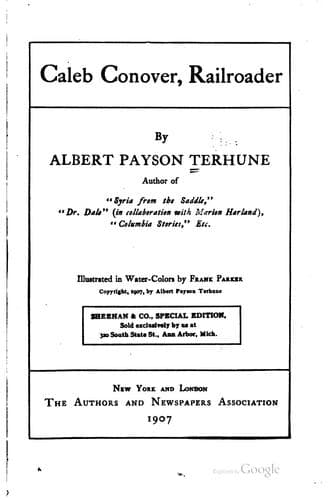
American fiction -- 20th century; Political fiction; Railroad stories; West (U.S.) -- Fiction
“Clear the way there, youse!” howled an insane, mumbling voice “Lemme at
’im! I’ll pay ’im for this smashed jaw!”
The press immediately in front of Clive Standish slackened and the crowd
opened. In its centre reeled a horrible figure—bloodstained, torn of
clothing, raging and distorted of face, one hand nursing an unshaven
jaw, while the other flourished a revolver.
“Lemme at ’im!” mumbled the pain-maddened tough through a hedge of
splintered teeth. “Clear the way or I’ll shoot to clear!”
Then, finding himself directly in front of Standish, the maniac halted
and levelled his weapon.
Something swished through the air from behind Clive’s head. A big
shapeless object hurtled forward and smote the broken-jawed tough full
across the eyes on the very instant he fired at point-blank range.
The ball went wild, and surprise at the odd blow he had received
(apparently from nowhere), caused the man’s pistol to clatter to the
ground.
The girl in the box—innocent cause of the whole battle—had paid her debt
to the man who had imperilled his life in her defence. She had crouched,
trembling, in the background watching the progress of the fray. But as
the intended murderer’s trigger-finger had tightened, she had hurled at
his face, with all her frail force, the huge bouquet she carried. For
once a woman’s aim was unerring, and thereby a man’s life was saved.
Her act—melodramatic, amazing, unlooked-for, eccentric in its poetic
justice and theatric effects—sent a roar of applause from the onlookers,
even as the pistol-shot momentarily startled the group of ruffians into
sanity. Clive, without awaiting the result of the shot, had flung
himself upon the little knot of toughs who were locked in death-grip
about Ansel.
But even as he did so, a cry of warning rang from a dozen parts of the
big building:
“The cops! Lights out! The cops!”
The hastily-summoned cohort of blue-coated reserves, pistols and
nightsticks drawn, charged down the centre aisle. And before their onset
the rabble melted like snow in April.
The historic Grafton Opera House riot was a thing of the past.
An hour later Clive Standish sat alone in his hotel room. Ansel had just
said good night to him and left him to his own miserable reflections.
Now that the excitement was over, he had time to realize what a ghastly
failure, from a campaign standpoint, his Grafton meeting had been. It
was the climax of his long, unbroken series of failures. He was beaten,
and he could no longer force himself to think otherwise.
Heart and mind and pride were as sore as the aching, bruised face and
body from which he had so recently washed the stains of battle.
At other towns he had scored nothing worse than failure. Here at Grafton
Conover had gained yet another point. The Railroader had made the people
look on his young opponent as a cheap trickster. The very class Clive
was working to rescue from Boss misrule would brand him as a charlatan.
Public-domain text, read in full here on John Shaqi.
Reviews
Reviews
No reviews yet
Be the first to share your thoughts on this work.
Elsewhere in the archive
Join the Discussion
Join the discussion
Sign in to leave a comment or review.
Sign InorCreate an account