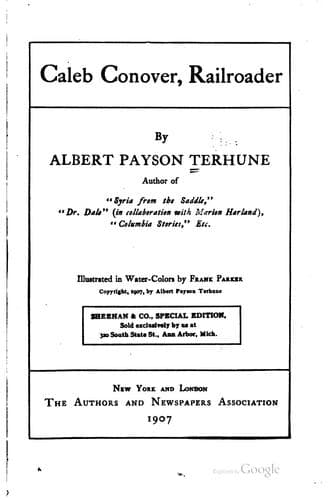
American fiction -- 20th century; Political fiction; Railroad stories; West (U.S.) -- Fiction
Standish went to the League’s headquarters, where for two hours he
busied himself with routine affairs, and tried to shut out memory of the
deep, taunting voice and masterful, amused eyes that had held him
captive, and had turned him from the real purpose of his visit. And in
time the light, sneering eyes deepened into liquid brown, and the
sonorous voice into Anice Lanier’s. For whatever theme might form any
particular verse of the day’s song for Clive, he noticed of late that
Anice was certain to be the ever-recurrent refrain.
Wearied with his evening’s work, Standish returned late to his own
rooms. His man said, as he helped the candidate off with his light
covert coat:
“A messenger boy brought a letter for you, sir, about an hour ago. He
said there was no answer. I left it on your desk.”
Clive picked up the typewritten envelope listlessly and tore it open. It
contained a note, also typewritten, and a thicker enclosure. He read:
“_Anonymous letters carry a stigma. Perhaps that is why you did not
profit by my last one. I have good reasons for not signing my name. And
you have good reason to know by now that what I write is the truth. Be
wiser this time. I enclose a list of the County Chairmen who have sold
out to Conover, the name of the Chairman to be chosen for next week’s
State Convention, and a rough draft of the plan to be used for your
defeat. Next to each detail you will find my suggestion for blocking it.
You owe it to yourself and to the people to take advantage of what I
send you._”
“He’s right, whoever he is!” exclaimed Clive, half-aloud. “It’s the only
way I can fight Conover on equal terms. There’s no sense in my standing
on a foolish scruple when so much hangs on the result of the
Convention.”
He snatched up the enclosure which had slipped to the floor. Irresolute
he held it for almost a minute, his firm lips twitching, his eyes cloudy
with perplexity. Then, with a sigh of self-contempt he slipped note and
enclosure in a long envelope, addressed it and rang for his man.
“See that this is delivered to-night,” he ordered.
The valet, as he left the room, glanced surreptitiously at the
envelope’s address. To his infinite bewilderment he saw the
superscription:
“_Caleb Conover, Esq., 167 Pompton Avenue. Personal._”
There was a terrible half hour in the Mausoleum that night.
CHAPTER IX
A CONVENTION AND A REVELATION
The day of the State Convention!
The Convention Hall at Granite was a big barn-like building, frequently
used for church and school entertainments, and occasionally giving a
temporary home to some struggling theatrical company. For the holding of
the convention which was to name the Governor of the Mountain State a
feeble attempt at decorating the vast interior had been made by
Conover’s State chairman.
Public-domain text, read in full here on John Shaqi.
Reviews
Reviews
No reviews yet
Be the first to share your thoughts on this work.
Elsewhere in the archive
Join the Discussion
Join the discussion
Sign in to leave a comment or review.
Sign InorCreate an account