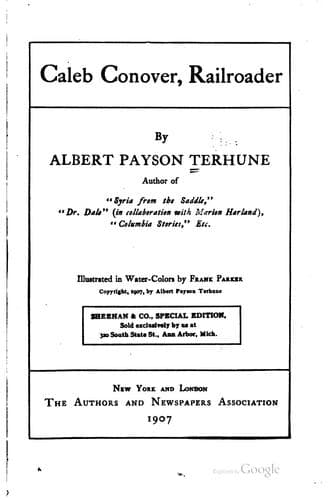
American fiction -- 20th century; Political fiction; Railroad stories; West (U.S.) -- Fiction
To the layman such an order may mean little. To the convention it meant
everything. Six counties were, officially, for Conover. Two for
Standish. Thus eighteen of Caleb’s adherents could, and would, vote to
ratify the seating of the Railroader’s delegates. The opponents of this
weird measure could muster a numerical force of but six.
Meanwhile, the preliminary organization of the convention had been
effected without much delay. The Standish delegates, knowing the
futility of making a fight at this time, had raised merely a perfunctory
opposition to the nomination of Bourke as temporary chairman. Through
Bourke (by way of Shevlin) Conover now proclaimed his plan of choosing
the all-important Committee on Credentials.
Bourke, well drilled, repeated the decision in a droning monotone.
Instantly the convention was in the maddest uproar. All semblance of
order was lost. Bedlam broke loose. In the gallery the contesting
Standish delegates writhed in impotent rage, leaning far over the rail,
shaking their fists and howling down insult, curse and threat.
On the floor the delegates from Wills and Matawan were already upon
their feet, yelling furious protests, shrieking “Fraud;” “Robbery!” and
kindred pleasantries, without trying or hoping to secure recognition
from the chair.
Foreseeing the inevitable trend of affairs, the Conover “heelers” and
the fraudulent delegates from the six larger counties had been prepared
for this. At a signal from Billy Shevlin they burst into a deafening
uproar of applause.
The furtive-faced Bourke rapped on the table, but the bang of his heavy
gavel was unheard. The Standish delegates would not be quieted, and the
Conover crowd did not want to be.
A dozen fist-fights started simultaneously. A ’longshoreman—Conover
district captain from one of the “railroad” wards of Granite—wittily
spat in the face of a vociferating little farmer from Wills County, and
then stepped back with a bellow of laughter at his own powers of
repartee. But others understood the gentle art of “retort courteous”
almost as well as he. Losing for once his inherited New England calm,
Karl Ansel drove his big gnarled fist flush into the grinning face of
the dock-rat, and sent him whirling backward amid a splintering of
broken seats.
As the ’longshoreman staggered to his feet, wiping the blood from his
face, the sergeant-at-arms (foreman of a C. G. & X. section gang), made
a rush for Ansel, but prudently held back as the gaunt old man fell on
guard and grimly awaited his new opponent’s onset.
Ansel, smarting and past all control, ploughed his way down the main
aisle, and halting below the stage, shook his clenched fist at Caleb’s
crayon likeness.
“I’ve seen forty pictures of Judas Iscariot in my time,” he thundered,
apostrophizing the portrait in a nasal voice that rose high above the
clamor, “and no two of them looked alike. But by the Eternal, they _all_
were the living image of YOU!”
Public-domain text, read in full here on John Shaqi.
Reviews
Reviews
No reviews yet
Be the first to share your thoughts on this work.
Elsewhere in the archive
Join the Discussion
Join the discussion
Sign in to leave a comment or review.
Sign InorCreate an account