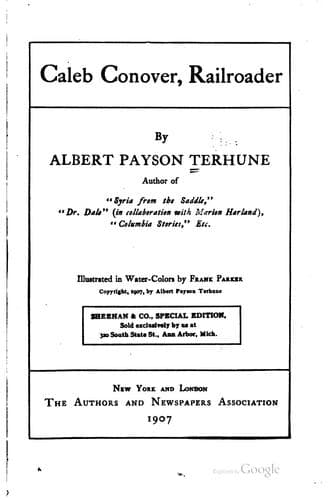
American fiction -- 20th century; Political fiction; Railroad stories; West (U.S.) -- Fiction
Clive had not meant to say it. He was sorry before the words had passed
his lips. Yet it was the first lucid thought that came to him as his
mind cleared from the first shock of Anice’s revelation. He knew how
fully Conover believed in this pretty secretary of his; how wholly the
Railroader had, in her case, departed from his life rule of universal
suspicion. That she should thus, coldbloodedly, calculatingly, have
betrayed the trust of even such an employer as Caleb was monstrous. He
could not reconcile it with anything in his own long knowledge of her.
The revelation turned him sick.
“You despise me, don’t you?” she asked. There was no shame, no faltering
in her clear young voice.
“I have no right to—to judge anyone,” he stammered. “I——”
“You despise me.” And now it was a statement, not a query.
“No,” he said, slowly, trying to gauge his own tangled emotions, “I
don’t. I don’t know why I don’t, but I don’t. I should think anyone else
that did such a thing was lower than the beasts. But you—why, _you_ are
yourself. And the queen can do no wrong. I’ve known you nearly all your
life. If it had been possible for you to harbor a mean or dishonest
impulse I’d have been the first person on earth to guess it. Because no
one else would have cared as I did. As I _do_. I don’t understand it at
all. And just at first it bowled me over, and a whole rush of disloyal
thoughts and doubts came over me. But I know now it’s all right,
somehow, for it’s _you_.”
“You mean,” exclaimed the girl, wonderingly, “that after what I’ve told
you, you trust me?”
“Why, of course.”
“And you don’t even ask me to explain?”
“If there was anything I had a right to know—that you wanted me to
know—you’d have explained of your own accord.”
She looked at him long, searchingly. Her face was as inscrutable as the
Sphinx’s, yet when she spoke it was of a totally different theme.
“What are you going to do?” she inquired.
“Do?” he repeated, perplexed.
“Yes, about the campaign.”
“There’s nothing to do. I am beaten. When the convention meets, in half
an hour, Conover will be nominated. Only my two little blocks of
delegates will be left to oppose him, against all that whole——”
“Yes; yes, I know that,” she interposed, “but what then?”
“That is the end, I suppose. Perhaps by the next gubernatorial
campaign——”
“The next? _This_ campaign hasn’t fairly begun yet. Do you mean to say
you are going to sit by with folded hands and accept defeat?”
“What else is left?”
“Everything is left. You have tried to fight an all-powerful machine, to
fight it on its own ground, along its own lines, yet refusing to use its
own weapons or to guard against them. And you have failed. The _real_
fight begins now.”
“What do you mean?”
Public-domain text, read in full here on John Shaqi.
Reviews
Reviews
No reviews yet
Be the first to share your thoughts on this work.
Elsewhere in the archive
Join the Discussion
Join the discussion
Sign in to leave a comment or review.
Sign InorCreate an account