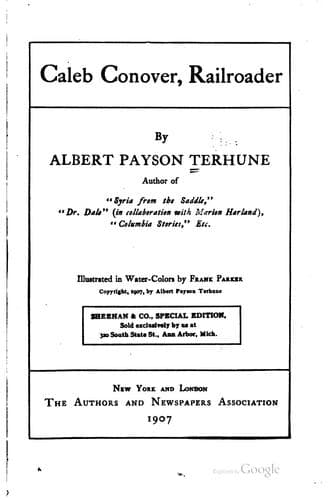
American fiction -- 20th century; Political fiction; Railroad stories; West (U.S.) -- Fiction
“I have said it awkwardly,” he began. “If it had been less to me I might
have found more eloquence. I love you. I think I have always loved you.
You know that. A woman always knows. I love you. I loved you in the old
days, when I was too poor to have the right to speak. What little I
am—what little I may have achieved—is for _you_. I have not made much of
myself. But that I’ve made anything at all is due to you. In everything
I have done, your eyes and your smile have been before me. At heart,
I’ve laid every success at your feet. At heart I’ve asked your faith and
your pardon for each of my failures. And, whether you care or not, it
will always be the same. That one dear ambition will spur me on to make
the very best of myself. My victories shall be your victories whether
you wish it or not. Perhaps that seems to you presumptuous or foolish?”
“No.”
There was no perceptible emotion in the half-whispered word. From it
Clive could glean nothing. Presently he went on:
“I think whenever you see a man trying to make the most of all that is
in him, and wearing out his very soul in this breakneck American race
for livelihood, you’ll find there is some woman behind it all. It is for
her, not for his own selfish ambition, that he is fighting. Sometimes
she crowns his victory. Sometimes he wins only the thorn-crown. But the
glory of the work and the winning are hers. Not his. Now you know why I
entered this Governorship fight, and why I am willing to keep it up. Oh,
sweetheart, I _love_ you so. You _must_ understand, now, why I longed to
come to you in my hour of triumph and——”
“You would have come too late,” she said in that same enigmatic
undertone.
“_Anice._”
There was a world of pain in his appeal, yet she disregarded it; and,
with face averted, hurried on:
“Would you care for—for the love of a girl who made you wait until you
could buy her with fame and an income? Do I care for the love of a man
who holds that love so cheaply he must accompany its gift with a
Governorship title——?”
“And now,” she observed, some minutes later, as she strove to rearrange
her tumbled crown of rust-colored hair before the tiny patch of office
mirror, “and now, if you can be sensible for just a little while, we’ll
go back to the convention. And I’ll explain to you about those letters.
The anonymous ones.”
“It’s all right. I don’t have to be told. I——”
“But I have to tell you. That’s the worst of being a girl.”
The crowd had trooped back into the Convention Hall. Gerald Conover had
not been at the earlier session, but now, his sallow face flushed with
liquor, he sat silent and dull-eyed among a party of noisy young
satellites, in one of the dingy, chicken-coop boxes at the side of the
stage.
He had evidently been drinking hard. In fact, since his wife’s visit to
Granite, the previous week, the youngster had seldom if ever been wholly
sober. Nor was his habitual apathy all due to drink.
Public-domain text, read in full here on John Shaqi.
Reviews
Reviews
No reviews yet
Be the first to share your thoughts on this work.
Elsewhere in the archive
Join the Discussion
Join the discussion
Sign in to leave a comment or review.
Sign InorCreate an account