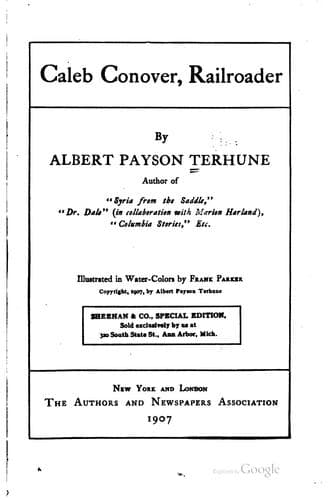
American fiction -- 20th century; Political fiction; Railroad stories; West (U.S.) -- Fiction
“I tell you,” thundered Clive, beside himself with excitement, “we have
got to act—and to act _now_. I tell you that the people of this State,
irrespective of party, are waiting for half a chance to throw off the
yoke of the railroad—of the Machine. All over this country of ours
bosses are being overthrown. They are going down to ruin in the wreckage
of their own Machines; and it is the PEOPLE who are downing them. The
day of Bossism is passing—passing forever. We came into this convention
as free men. _Some_ of us did. And I for one propose to walk out of it a
free man. If we go before the people of this State on the issue of
honest government as opposed to dishonesty, I tell you that we will
_win_. It only needs a man with a match, and the nerve to use that
match, to start a conflagration that will burn party ties to cinders and
leave a free, emancipated people.
“Let them call me bolter, if they will! Let them call me traitor,
ingrate, renegade! I would rather be a bolter than a thief. I would
rather rip my party, dearly as I love it, to rags and tatters, than to
sacrifice my own self-respect any longer! I would rather see the
Democratic party pass from existence altogether than to see it continue
the tool and the creature of greed and dishonesty.
“Yes, they may call me bolter, and properly so, for I am going to bolt
this convention! Is there a man who will follow me out of doors? Out of
the filthy atmosphere of this Machine-ridden, Boss-owned convention,
into the pure sunshine of God’s own people?”
In the midst of an indescribable tumult, in which hisses and cheers were
madly intermingled, Clive Standish leaped off the platform, cleared the
orchestra railing and strode up the middle aisle toward the open door at
the far end of the hall.
And then a strange thing occurred. Karl Ansel, as a man wakened from a
dream, rubbed his eyes, and peered for a moment at Clive’s retreating
back. Then with a yell that shook the rafters he, too, bounded over the
rail and hastened up the aisle behind his leader.
The delegates from Wills and Matawan counties arose as one man, forming
in procession behind Ansel and Standish.
Down the steps from the gallery came not one, nor a dozen, but
nine-tenths of those who had heard the speech, including the very cream
of the representative business element of Granite.
The remarkable scene was over in almost less than it takes to tell of
it. In a daze sat the abandoned convention. Glancing about them, even
the Conover delegates on the floor discovered here and there vacant
chairs, gaps in their own solid ranks, where some one, weaker perhaps
than the others—or perhaps stronger—had been moved by the furious
oratory of Clive Standish to join that procession which even now was
rolling out of the front door into the quiet, gaslit street like a
living avalanche.
Public-domain text, read in full here on John Shaqi.
Reviews
Reviews
No reviews yet
Be the first to share your thoughts on this work.
Elsewhere in the archive
Join the Discussion
Join the discussion
Sign in to leave a comment or review.
Sign InorCreate an account