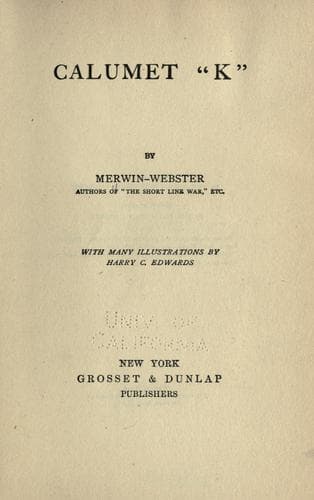
Engineers -- Fiction; Grain elevators -- Design and construction -- Fiction; Psychological fiction
Bannon answered one or two more questions rather at random, then suddenly
came back to earth. "What are you doing here, anyway?" he demanded. "Seems
to me this is a pretty easy way to earn thirty cents an hour."
"I--I was just going to see if there wasn't something I could do," the man
answered, a good deal embarrassed. Then before Bannon could do more than
echo, "Something to do?" added: "I don't get my time check till midnight.
I ain't on this shift. I just come around to see how things was going.
We're going to see you through, Mr. Bannon."
Bannon never had a finer tribute than that, not even what young Page said
when the race was over; and it could not have come at a moment when he
needed it more. He did not think much in set terms about what it meant,
but when the man had gone and he had turned back to the window, he took a
long breath of the night air and he saw what lay beneath his eyes. He saw
the line of ships in the river; down nearer the lake another of Page's
elevators was drinking up the red wheat out of the hold of a snub-nosed
barge; across the river, in the dark, they were backing another string of
wheat-laden cars over the Belt Line switches. As he looked out and
listened, his imagination took fire again, as it had taken fire that day
in the waiting-room at Blake City, when he had learned that the little,
one-track G.&M. was trying to hinder the torrent of the Northern wheat.
Well, the wheat had come down. It had beaten a blizzard, it had churned
and wedged and crushed its way through floating ice and in the trough of
mauling seas; belated passenger trains had waited on lonely sidings while
it thundered by, and big rotary ploughs had bitten a way for it across the
drifted prairies. Now it was here, and Charlie Bannon was keeping it
waiting.
He stood there, looking, only a moment; then before the carpenter's
footsteps were well out of hearing, he followed him down the stairway to
the belt gallery. Before he had passed half its length you could have seen
the difference. In the next two hours every man on the elevator saw him,
learned a quicker way to splice a rope or align a shaft, and heard, before
the boss went away, some word of commendation that set his hands to
working the faster, and made the work seem easy. The work had gone on
without interruption for weeks, and never slowly, but there were times
when it went with a lilt and a laugh; when laborers heaved at a hoisting
tackle with a Yo-ho, like privateersmen who have just sighted a sail;
when, with all they could do, results came too slowly, and the hours flew
too fast. And so it was that Christmas night; Charlie Bannon was back on
the job.
About ten o'clock he encountered Pete, bearing off to the shanty a quart
bottle of cold coffee and a dozen big, thick sandwiches. "Come on,
Charlie," he called. "Max is coming, too; but I guess we've got enough to
spare you a little."
Public-domain text, read in full here on John Shaqi.
Reviews
Reviews
No reviews yet
Be the first to share your thoughts on this work.
Elsewhere in the archive
Join the Discussion
Join the discussion
Sign in to leave a comment or review.
Sign InorCreate an account