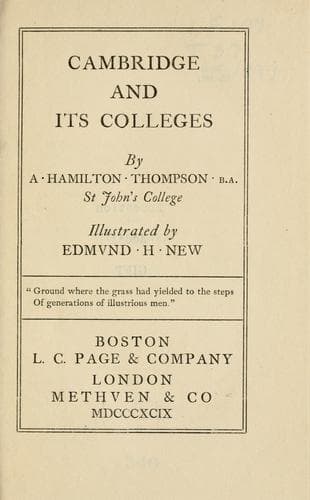
Cambridge and Its CollegesThompson, A. Hamilton (Alexander Hamilton)
History
Cambridge and Its Colleges
Thompson, A. Hamilton (Alexander Hamilton)
University of Cambridge
As time went on, the Puritanism of Emmanuel became more and more
pronounced. The services in the chapel savoured of Congregationalism
and were altogether opposed to the Laudian revival of church life and
doctrine. Under the first Dr Sancroft, the college ritual was thus
reported to the Archbishop, “They receive that Holy Sacrament, sitting
upon forms about the Communion Table, and do pull the Loaf one from the
other, after the minister hath begun. And so the Cup, one drinking as it
were to another, like good fellows, without any particular application
of the said words, more than once for all.” This expression of shocked
piety has nothing in its wording which allows us to expect exaggeration.
The servers at the altar were also “Fellows’ subsizars,” and not in holy
orders. However, one fails to see any extravagant Protestantism in this
arrangement. Emmanuel chapel must have presented a strange contrast to
Wren’s and Cosin’s chapel at Peterhouse, or to the chapel at Queens’
which Dowsing ransacked so unceremoniously. The college, meanwhile, was
the nursery of American colonisers, and has therefore always been a goal
of American pilgrimage. Mr Everett’s bombastic passage on the subject has
been often quoted; its eloquence is scarcely of the finest type. But, in
company with a row of Pilgrim Fathers, Emmanuel produced John Harvard,
the founder of the greatest American University, and may therefore be
called the mother of American education.
But, in common with St John’s and other colleges, Emmanuel lost its
Puritanism with years. The Restoration brought in a better state of
feeling, and, under the second Dr Sancroft and his successors, Doctors
Breton* and Holbech,* the college devoted its energies to building.
William Sancroft became Archbishop of Canterbury, and kept up the
traditions of his college in refusing to acknowledge James II.’s
Declaration. He was the chief of the seven bishops who signed the famous
petition against that document. Afterwards, as a non-juror, he resigned
his archbishoprick. But the best of all the sons of Emmanuel was another
non-juror, William Law, who was for many years a fellow, and held the
living of King’s Cliffe in Northamptonshire. This great man has become
better known to the world since the publication of his biography by Canon
Overton, and the reprinting of his letters to Bishop Hoadly. He was a
staunch and able supporter of the Church’s principles, but his most
abiding monument is the half mystical but intensely practical treatise
called _A Serious Call to a Devout and Holy Life_. The book has had
an influence second only to that of the _Pilgrim’s Progress_, and its
wide application may be judged from the fact that it affected people so
widely different as Dr Johnson and Richard Hurrell Froude. Its simple
but vivid style and its picturesque quaintness, account very largely
for its popularity. In later years, Law, a solitary and meditative man,
Public-domain text, read in full here on John Shaqi.
Reviews
Reviews
No reviews yet
Be the first to share your thoughts on this work.
Elsewhere in the archive
Join the Discussion
Join the discussion
Sign in to leave a comment or review.
Sign InorCreate an account