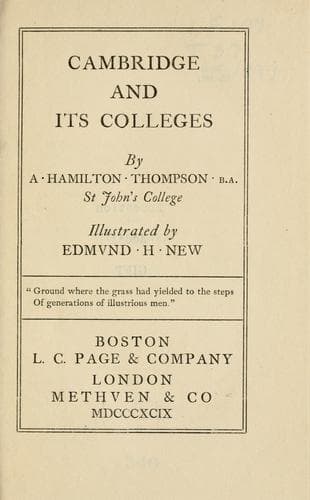
Cambridge and Its CollegesThompson, A. Hamilton (Alexander Hamilton)
History
Cambridge and Its Colleges
Thompson, A. Hamilton (Alexander Hamilton)
University of Cambridge
Newnham, which is in Cambridge itself, is a later foundation, but its
progress has been astonishing. It also takes its name from a suburban
village which has gradually become part of the town. The buildings of
Newnham form a very imposing array, and are a remarkable contrast, with
their Renaissance gables, to the Gothic buildings of Selwyn, just across
the road. Mr Basil Champneys has produced in them one of the best modern
imitations of French Renaissance; and their outline, seen at a favourable
distance, would not be unworthy of Chambord or Chenonceaux. The oldest
part is the Old Hall, forming the south-eastern angle of the college;
this belongs to 1875. Then came Clough Hall on the north side. Sidgwick
Hall followed it, and completed this side, and, in 1894, two sides of
a quadrangle were finished and the Old Hall joined to the rest by the
erection of the Pfeiffer Building. In this latest part of the college is
the principal gateway, now closed by a double gate of beautiful ironwork,
in memory of the first principal, Miss Clough. In the hall are portraits
of Miss Clough, Professor and Mrs Sidgwick, and Miss M. G. Kennedy, by
Mr J. J. Shannon, and one (by Richmond) of Miss Helen Gladstone, who
till lately was one of the leading Newnham dons. Young as they are, both
Girton and Newnham have their history, and are able to inspire their
students with a patriotism which is the natural result of extraordinary
perseverance and hardly-won victories.
[Illustration: Newnham College]
XXII
THE UNIVERSITY BUILDINGS
Fond tradition would compel us to accept the so-called School of
Pythagoras as the _fons et origo_ of the medieval University. However,
the legend does not go for very much, and we may suppose that, until the
foundation of several colleges brought about the necessity of a common
centre, education was carried on in the numerous monastic houses or by
private teachers at their own lodgings. The present schools, within the
limits of the University Library, are probably in part of the fourteenth
century, but, for the most part, belong to the latter half of the next
century. They are not very conspicuous, and probably ninety-nine out of
a hundred Cambridge men have never been inside them, as the majority of
public examinations are held in the Senate House and the various large
halls of which the town is full. They are, moreover, so incorporated in
the Library as to form part of the building, and have no very distinctive
mark.
[Illustration: The Senate House]
Public-domain text, read in full here on John Shaqi.
Reviews
Reviews
No reviews yet
Be the first to share your thoughts on this work.
Elsewhere in the archive
Join the Discussion
Join the discussion
Sign in to leave a comment or review.
Sign InorCreate an account