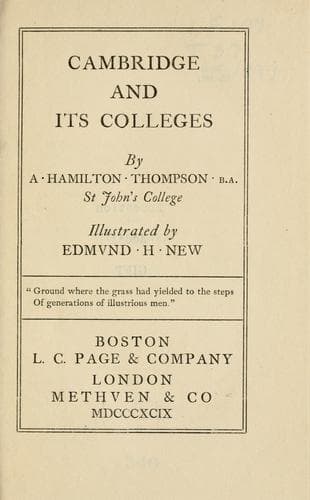
Cambridge and Its CollegesThompson, A. Hamilton (Alexander Hamilton)
History
Cambridge and Its Colleges
Thompson, A. Hamilton (Alexander Hamilton)
University of Cambridge
From Holy Trinity we pass down Sidney Street and into Bridge Street.
Just opposite St John’s Chapel is the church of the Holy Sepulchre,
generally known as the Round Church. This is one of the four churches of
the Templars which remain in England, and is the earliest. The Temple
Church in London was built several years later; St Sepulchre’s at
Northampton is later again; and the round church at Little Maplestead
in Essex belongs to quite the last years of the Order. The round portion
of the Cambridge church belongs to the earliest Norman period, and was
begun in the reign of William Rufus—that is, before 1100. It consists of
eight divisions. The round-headed arches of the ground-floor rest upon
massive round piers; dwarf piers on the same principle support the arches
of the triforium, which include a double arch separated by a slender
central pillar and springing from pilasters attached to the main piers.
The clerestory above is lighted by eight round-headed openings, splayed
inwardly. The ribs of the conical roof continue into the clerestory
and triforium and finish in the spandrils of the triforium arches with
grotesque corbels. Although all this is on a miniature scale, the effect
is very grand and solemn. The good taste of the last century blocked up
the triforium and filled the ground-floor with pews. The exterior had
been adorned much earlier with an upper storey. This, to be in harmony
with the late Perpendicular chancel, was crowned by an ugly battlement.
In 1841, the Cambridge Camden Society took the church in hand. Their
architect was Salvin, who restored it very well, taking down the upper
storey, adding a conical slate roof in agreement with tradition, and
opening out the Norman doorway. Unfortunately, the Society’s taste
in stained glass was not very advanced, and the gaudy east window by
Willement is not at all appropriate. Wailes’ glass in the round part is
much better, but is not all that could be desired. The Society’s stone
altar was the subject of a _cause celèbre_, and was pronounced illegal
by Sir Herbert Jenner Fust in 1845. This unhappy incident was the result
of the dissolution of a society which had done literally everything
for the cause of Cambridge archæology, and was no small factor in the
great Church revival of the forties. St Sepulchre’s is one of those rare
livings which are in the gift of the parishioners; and the burgesses of
the parish are very tenacious of their privilege.
Public-domain text, read in full here on John Shaqi.
Reviews
Reviews
No reviews yet
Be the first to share your thoughts on this work.
Elsewhere in the archive
Join the Discussion
Join the discussion
Sign in to leave a comment or review.
Sign InorCreate an account